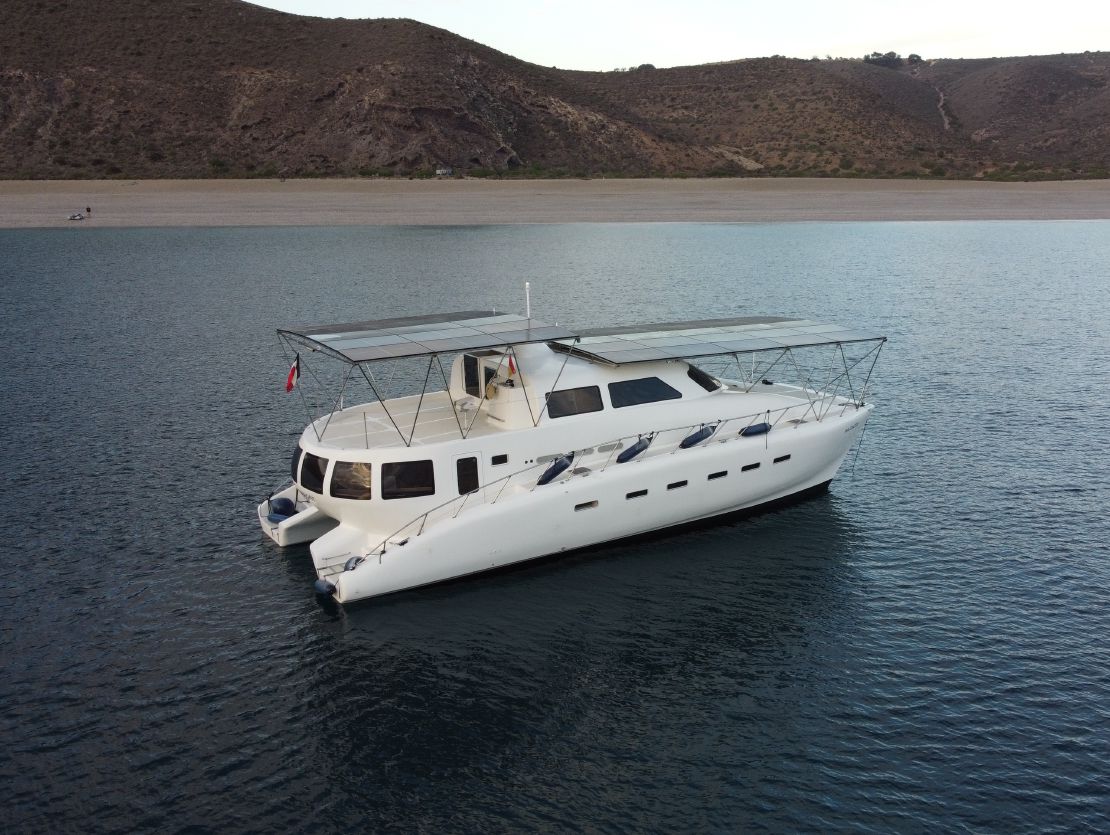
Fall and Winter 2024 Navigation Log
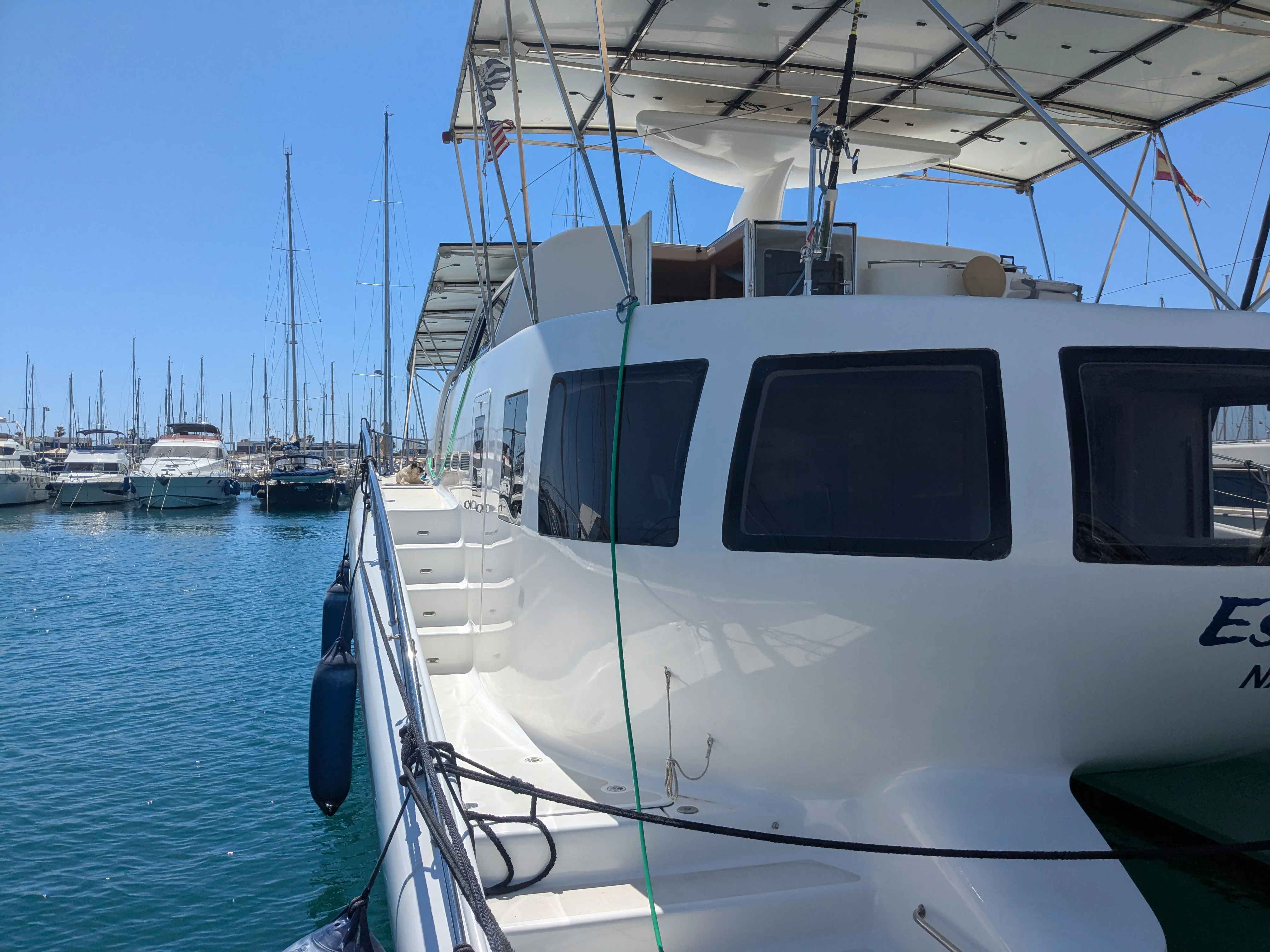
We kicked off our fall season by hosting several friends onboard before continuing our navigation along the southwest coast of Spain. Because we …
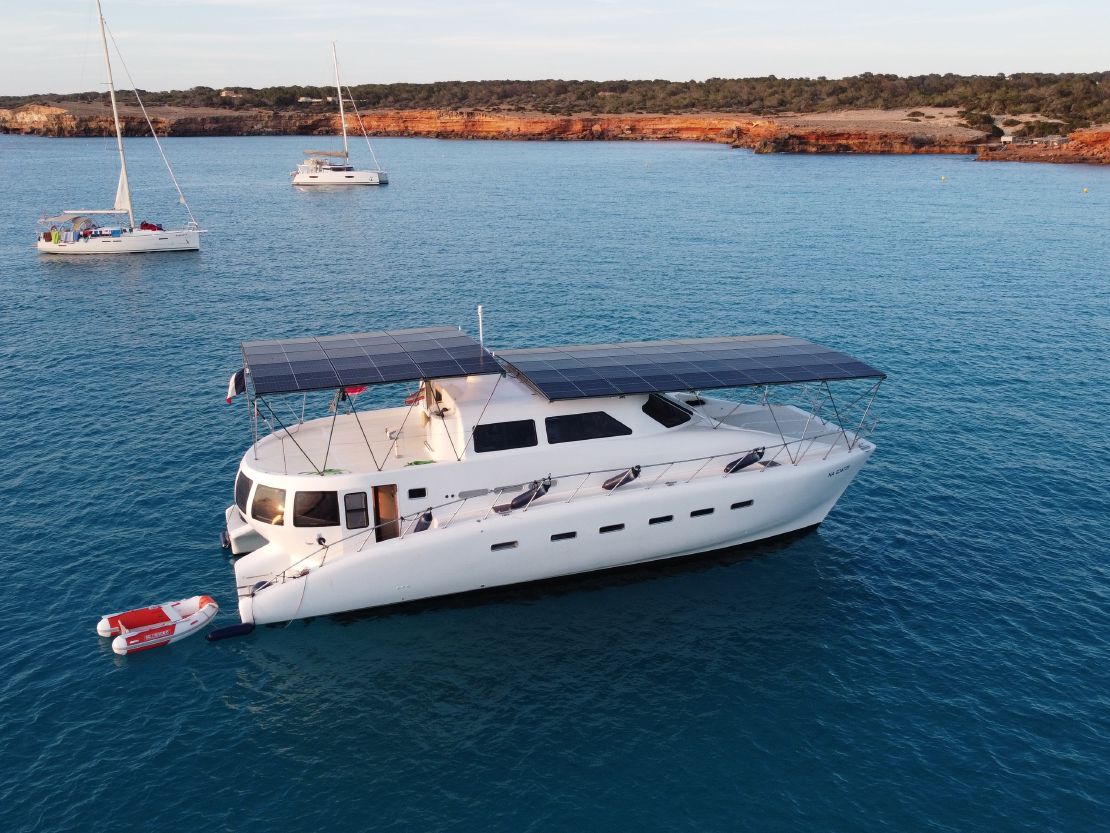
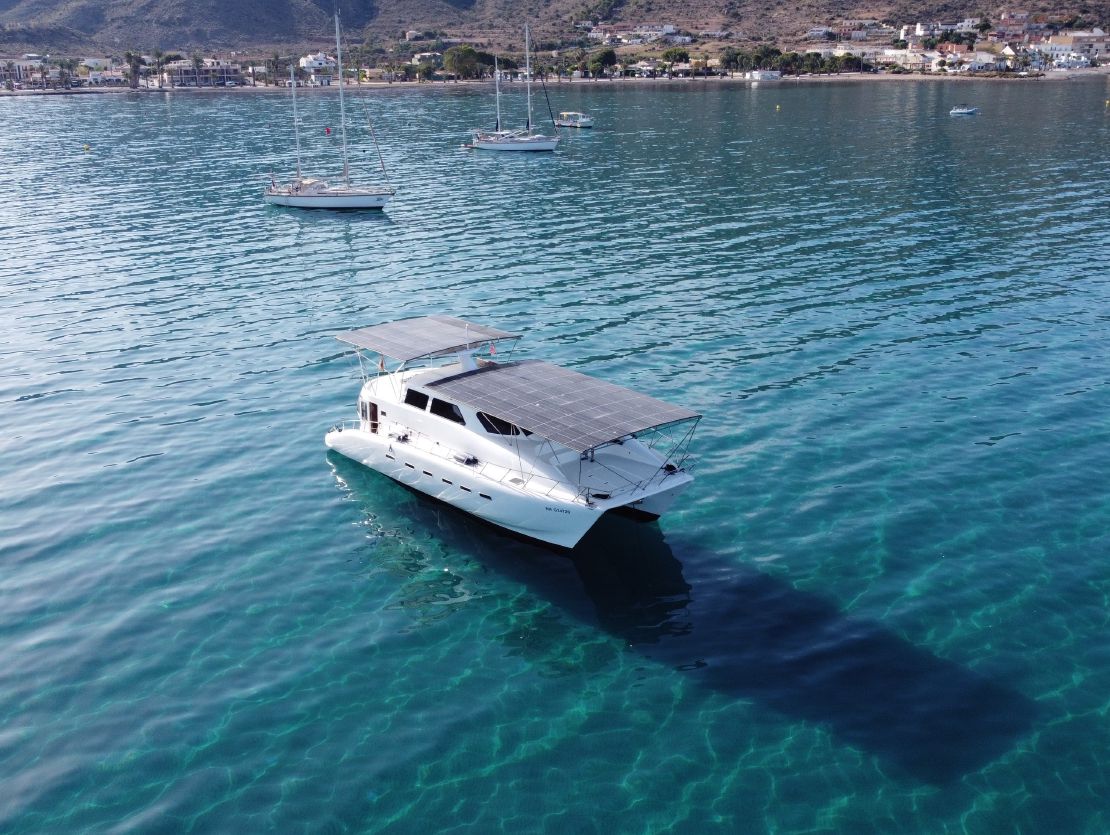
Our spring season was defined by a bold ambition: crossing to the Balearic Islands. Before setting off, we focused on finalizing our autopilot installation, as hand-steering during long navigation days had become increasingly taxing. It was bittersweet saying goodbye to Cartagena, our home port for over a year, and the many friends we made there. From there, we traced the coast up to Denia, crossed to Ibiza and Formentera, and experienced our first night passages before returning to Torrevieja to moor Escargot for the summer.
| Date | Distance | Speed | Duration | Description |
|---|---|---|---|---|
| 2025-04-13 | 40.0 nm | 3.9 kts | 10.3 h | Passage from Cartagena to Torrevieja |
| 2025-04-18 | 26.9 nm | 4.6 kts | 5.9 h | Passage from Torrevieja to Alicante |
| 2025-04-24 | 27.8 nm | 4.4 kts | 6.4 h | Passage from Alicante to L’Albir |
| 2025-04-25 | 7.5 nm | 3.5 kts | 2.1 h | Passage from L’Albir to Calpe |
| 2025-05-04 | 20.9 nm | 4.3 kts | 4.8 h | Passage from Calpe to Denia |
| 2025-05-08 | 57.4 nm | 4.3 kts | 13.4 h | Passage from Denia to Punta d’en Ribes on Ibiza |
| 2025-05-11 | 25.4 nm | 4.5 kts | 5.7 h | Passage from Ibiza to Es Pujols on Formentera |
| 2025-05-13 | 29.6 nm | 4.1 kts | 7.2 h | Navigation around Formentera to Marina Port Formentera |
| 2025-05-16 | 5.0 nm | 4.0 kts | 1.2 h | Short navigation from Marina Port Formentera to Cala Saona |
| 2025-05-18 | 63.1 nm | 3.5 kts | 18.0 h | Passage from Formentera to Calpe |
| 2025-05-19 | 4.1 nm | 3.4 kts | 1.2 h | Passage from Calpe to Altea |
| 2025-05-21 | 58.1 nm | 3.8 kts | 15.4 h | Passage from Altea to Torrevieja |
| 2025-05-22 | 0.4 nm | 2.5 kts | 0.1 h | Manoeuver to Marina Salinas Torrevieja |
Total distance: 366.1 nm
After several weeks of preparation in Cartagena, we were ready to depart the marina that had served as our home port for over a year. Our plan was to position ourselves for a crossing to Ibiza in the coming weeks. We booked a berth in Torrevieja as our first destination, 40 nautical miles away. The forecast called for sunshine and calm seas: perfect weather to kick off our spring season!
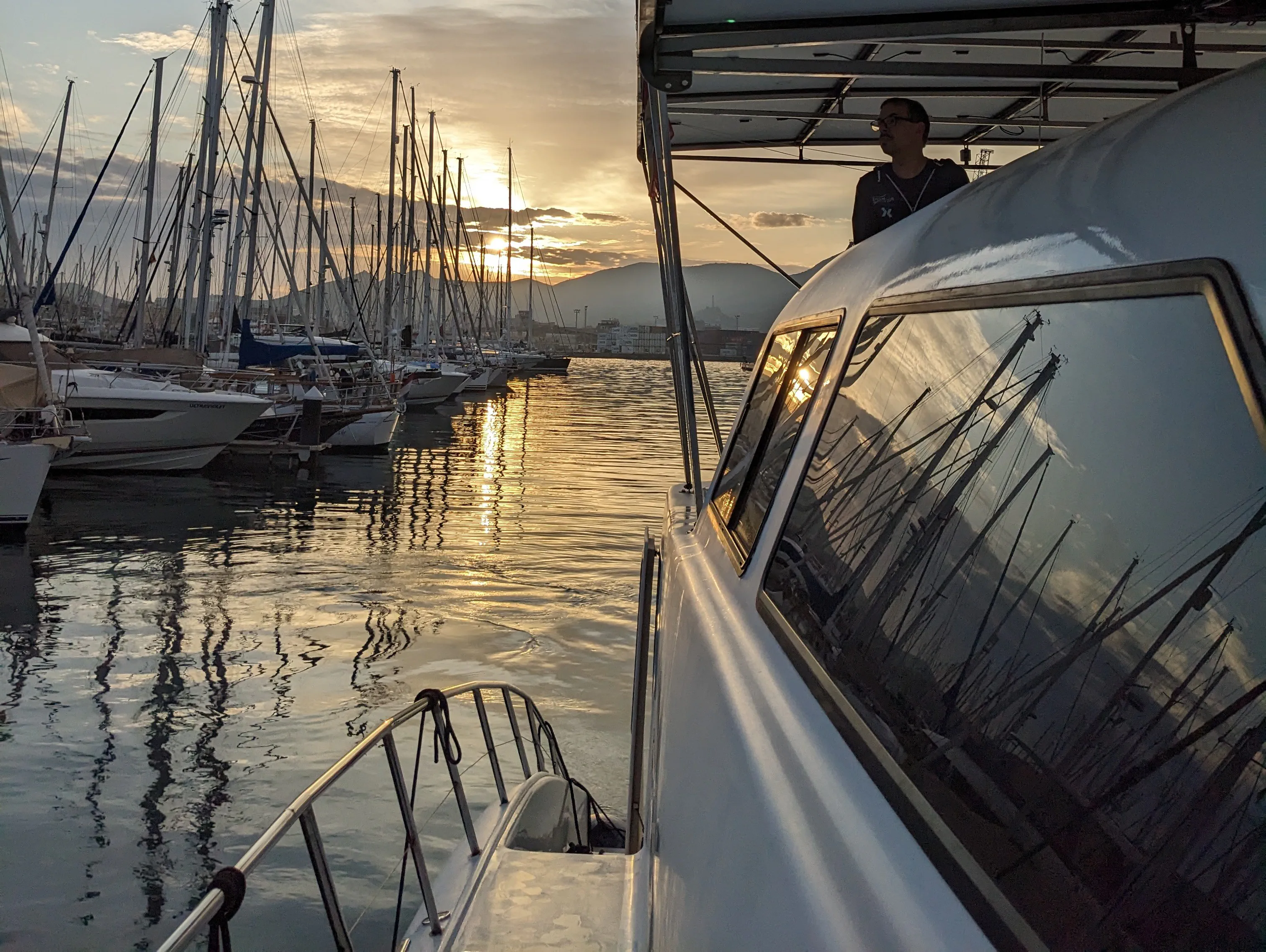
A major project over the previous two weeks was modifying our hydraulic autopilot system, which included adding a flow control block to the solenoid valves. Taking advantage of the lack of cargo activity in the harbor, we executed two perfect circles to calibrate the electronic compass and run the autopilot’s auto-learn mode.
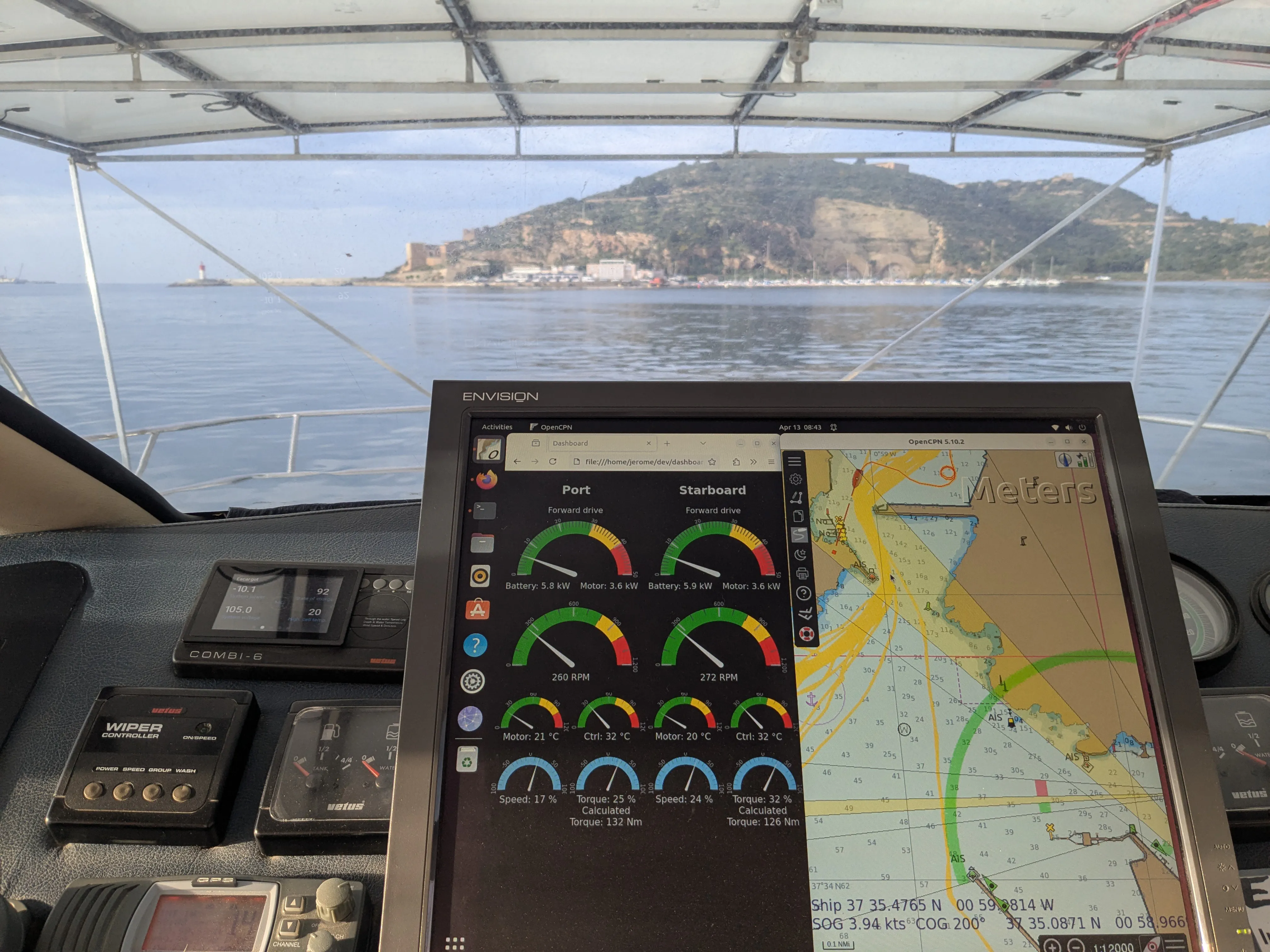
We departed with our battery bank at a 96% state of charge (SOC). While we expected typical April sunshine, the sky turned gray as we approached Cabo de Palos, bringing light rain. Under the overcast sky, our solar energy generation became quite limited.
This was our first passage using the autopilot on Escargot. It was a transformative experience to focus solely on the watch without having to constantly adjust the helm to maintain our heading.
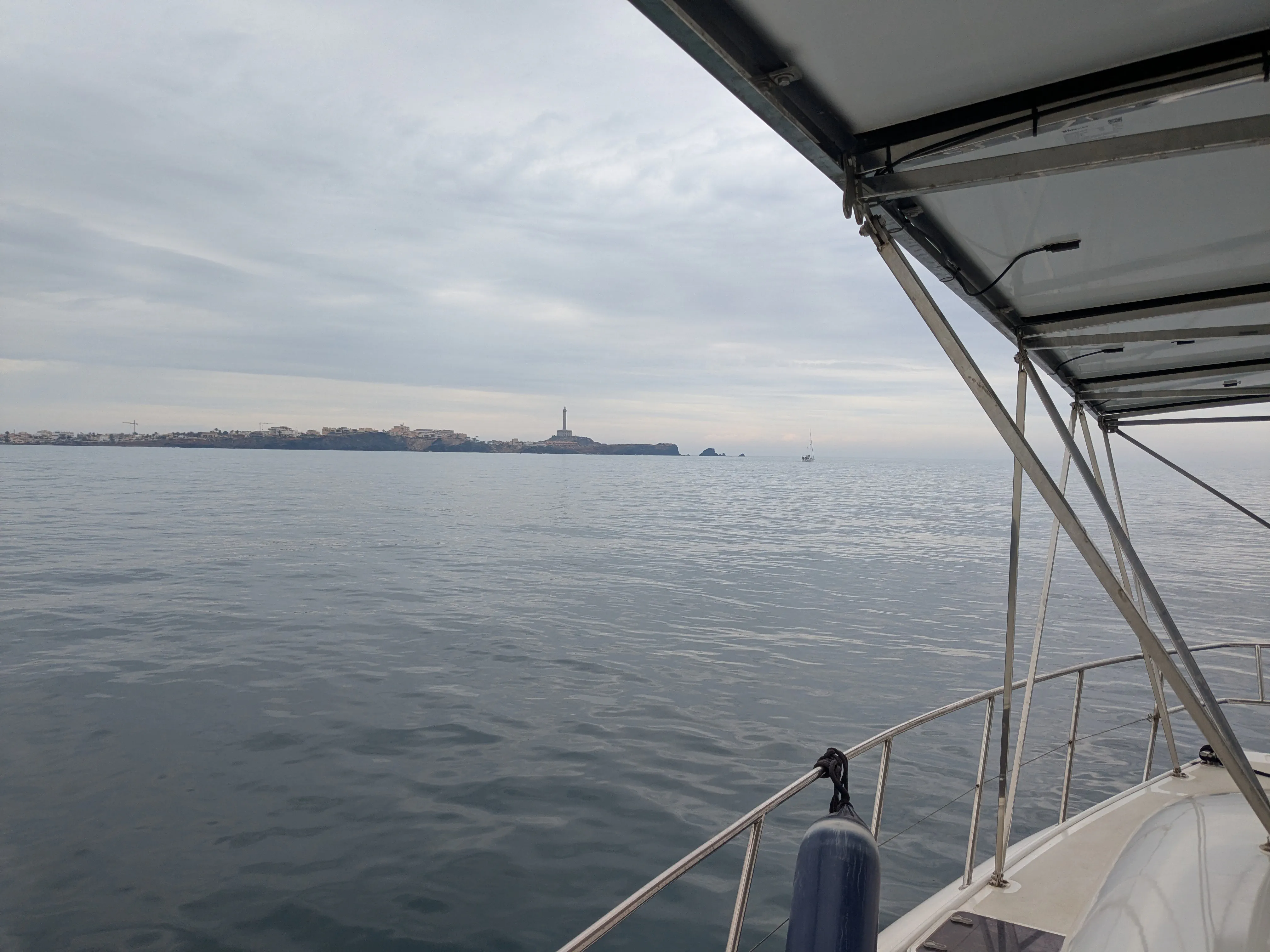
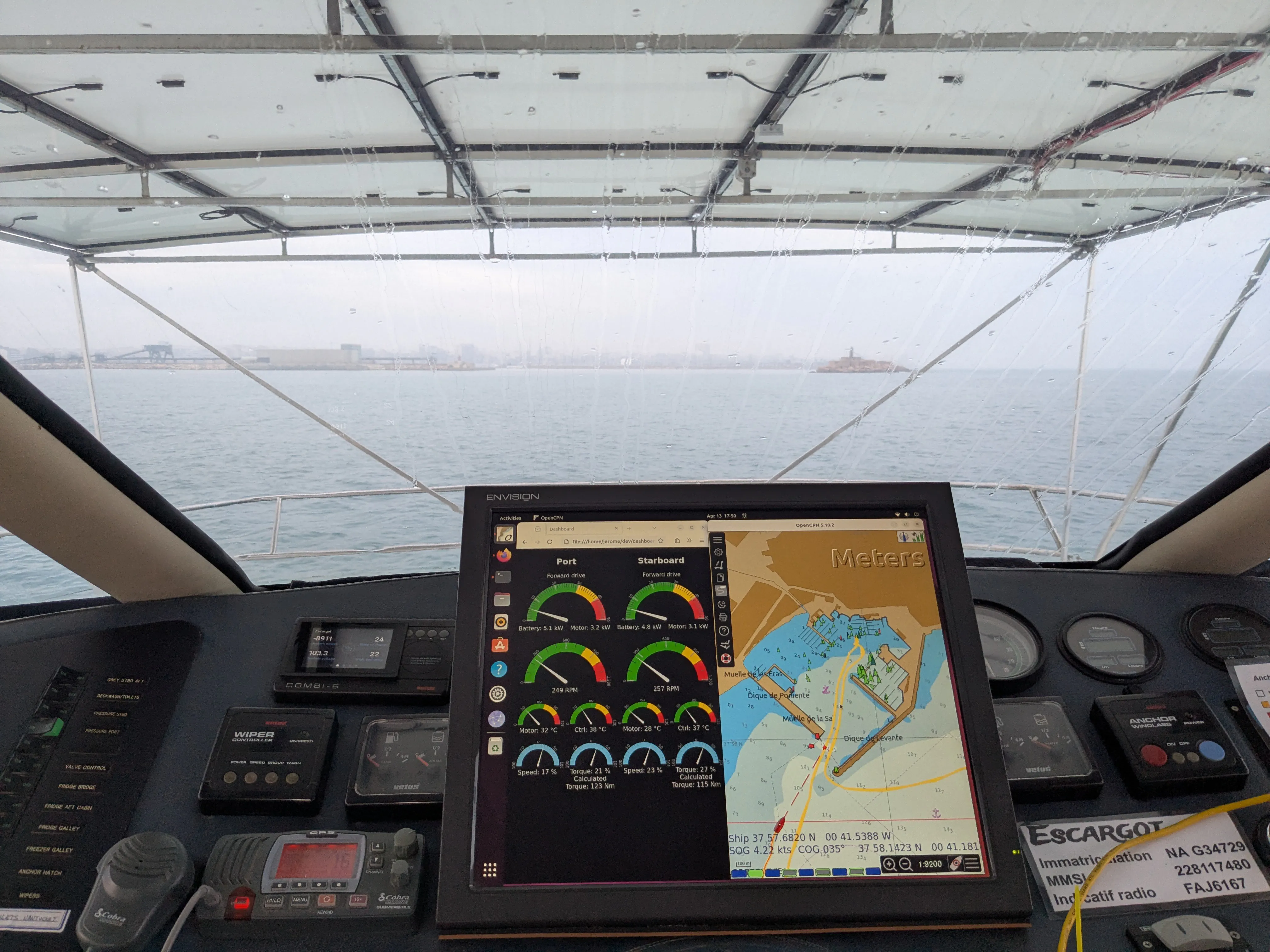
In addition to the lack of sun, we encountered a counter-current as we rounded Cabo de Palos and headed north. We realized that to reach Torrevieja before nightfall, we needed 15kW of power to maintain a speed above 4 knots. Given our 40% SOC and limited solar input, we decided to run our backup diesel generator for three hours to supplement the batteries.
By the time we were two hours from our destination, our SOC was at 41%, allowing us to safely shut down the generator. We arrived in Torrevieja under light rain and docked at Marina Salinas with 22% SOC remaining.
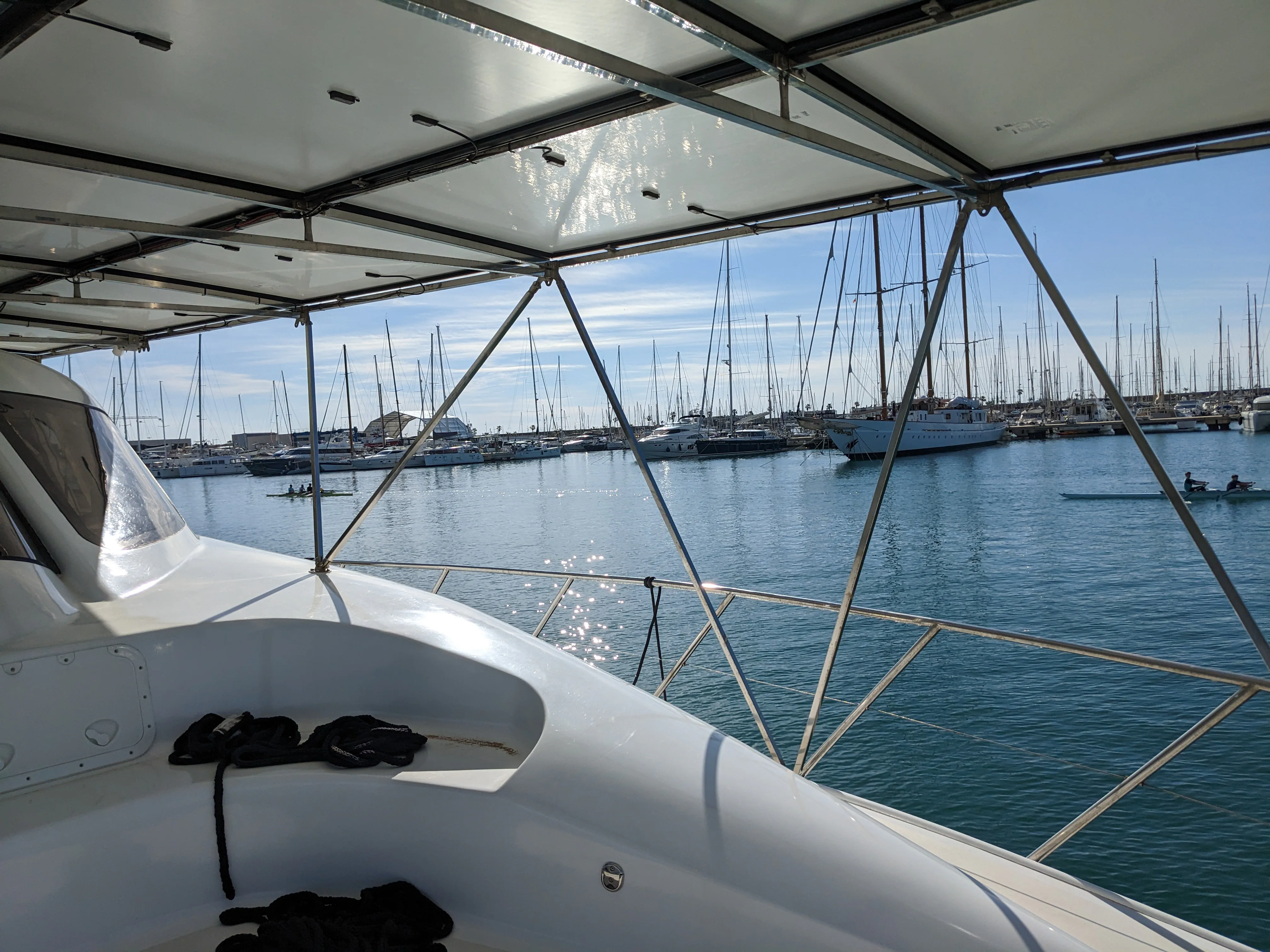
Following several days of stormy weather in Torrevieja, a clear window finally opened for our trip to Alicante. We had arranged for a liferaft delivery there, the final piece of safety equipment required for our upcoming crossing to Ibiza.
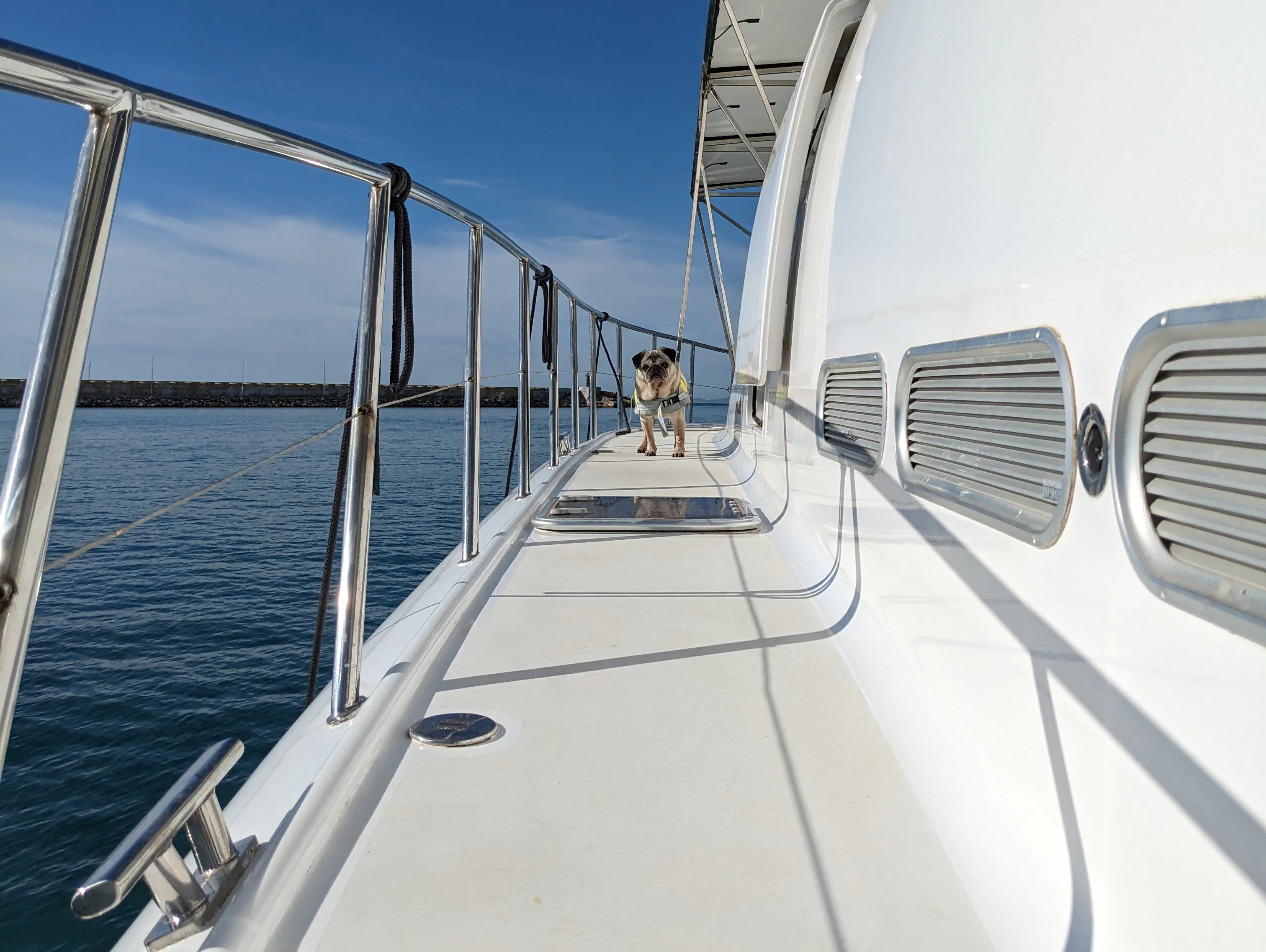
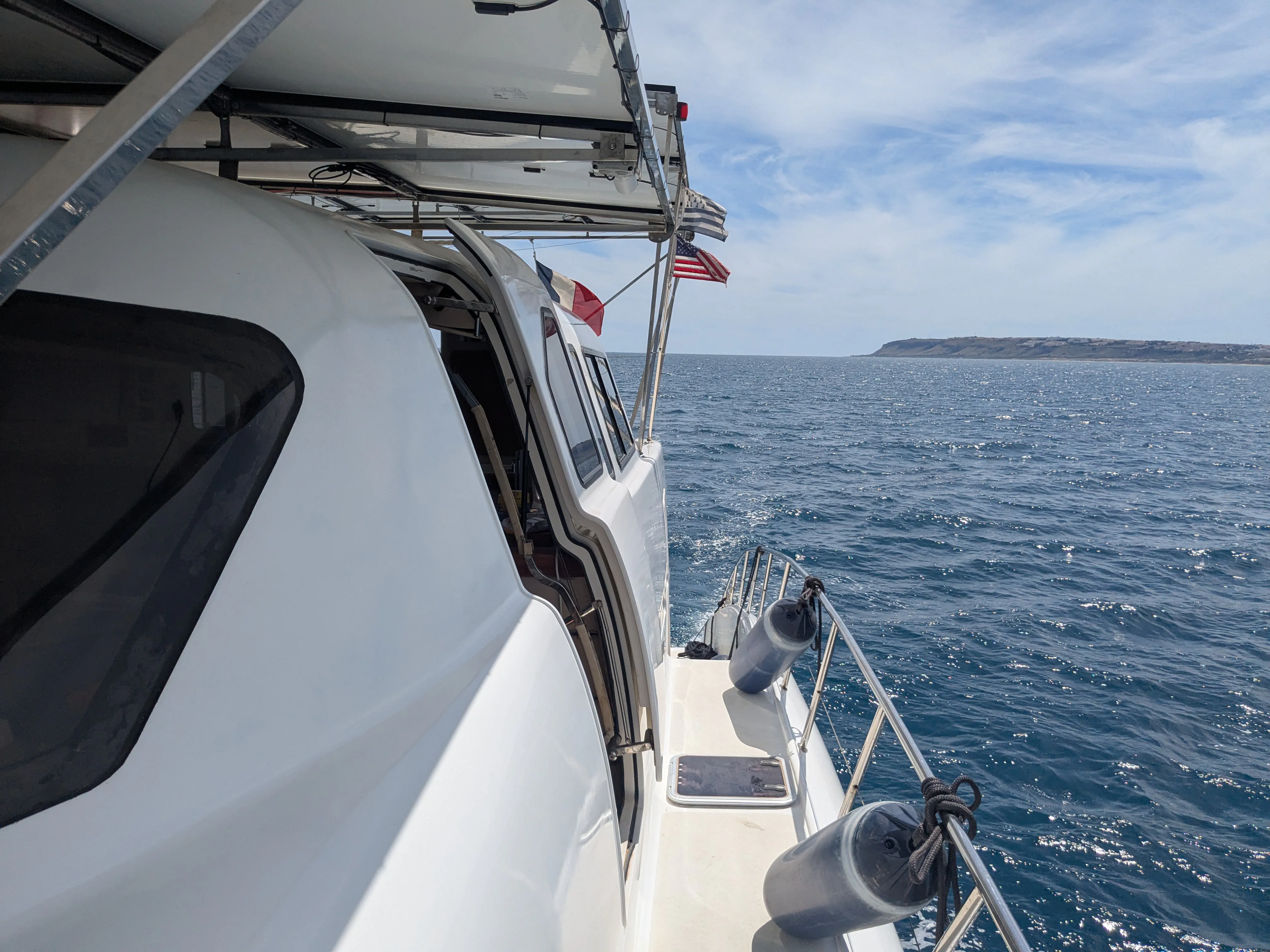
The leg was only 27 nautical miles. With a 100% SOC and clear skies, we anticipated an easy navigation. The weather was so pleasant that even BigBoy enjoyed being on deck, wearing his lifejacket, of course!
By late morning, we set our speed to 4.5 knots, consuming 13kW. Thanks to strong solar generation, our net consumption was only 6kW.
As we navigated the passage between Santa Pola and the island of Tabarca, we had to stay alert for fast passenger ferries. Having AIS targets displayed on our navigation computers made this much simpler than guesstimating vessel headings by watching the horizon.
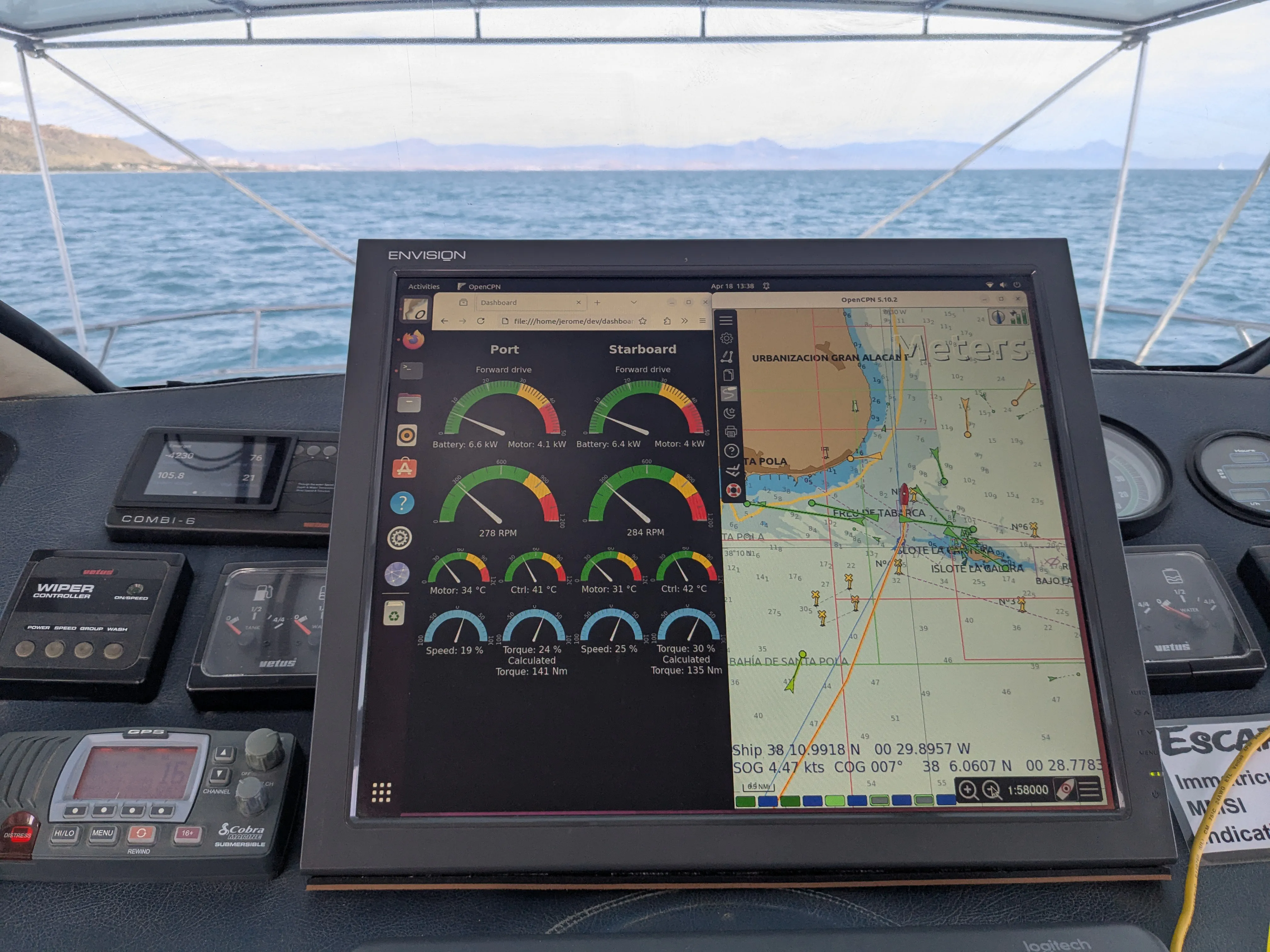
It was wonderful to be back in the Bay of Alicante, the same area where we conducted our initial sea trials a few years ago.
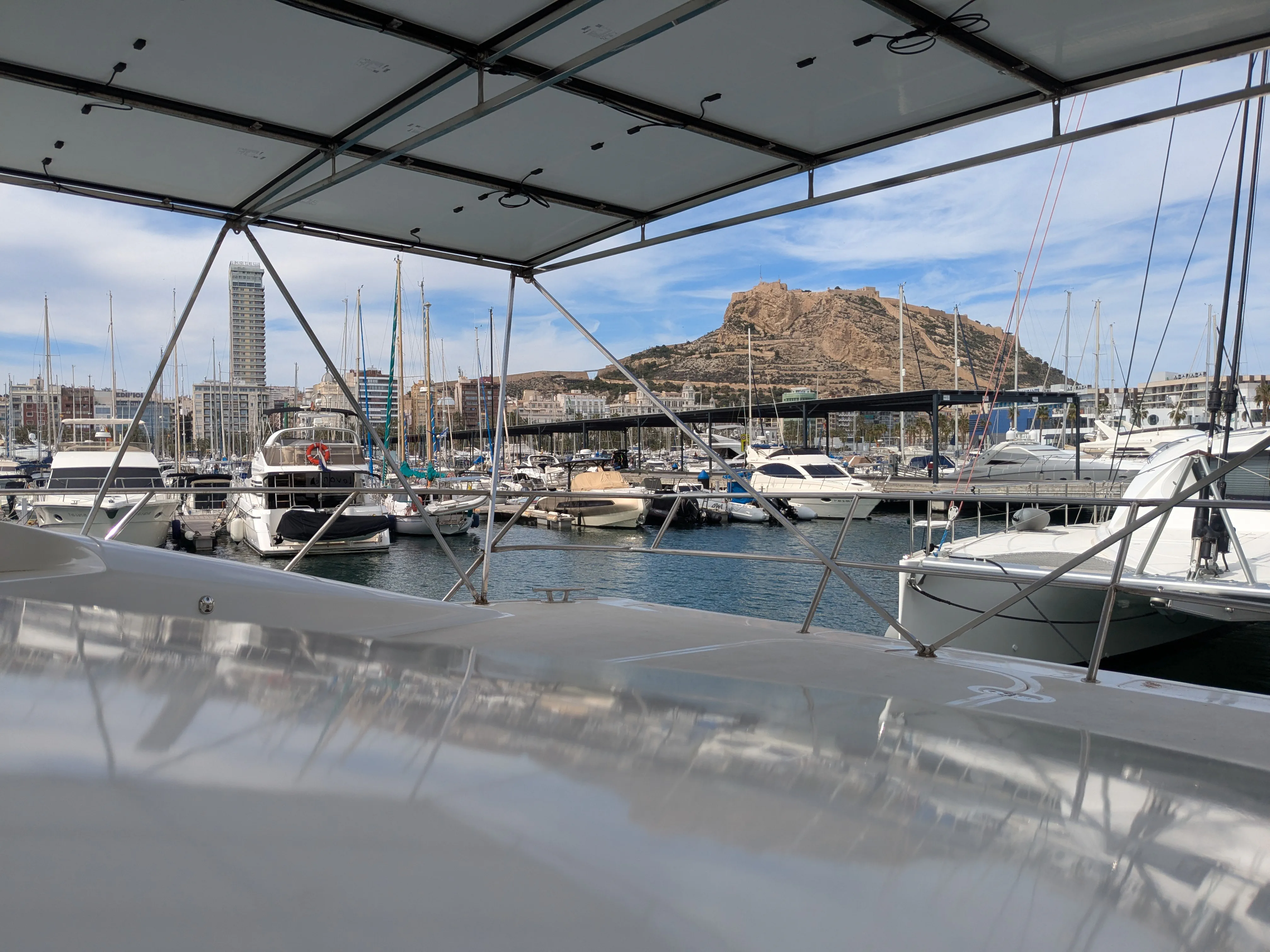
We arrived at the visitor dock of Marina Alicante with 66% SOC remaining, feeling excited at the sight of the Castle of Santa Barbara overlooking the city.
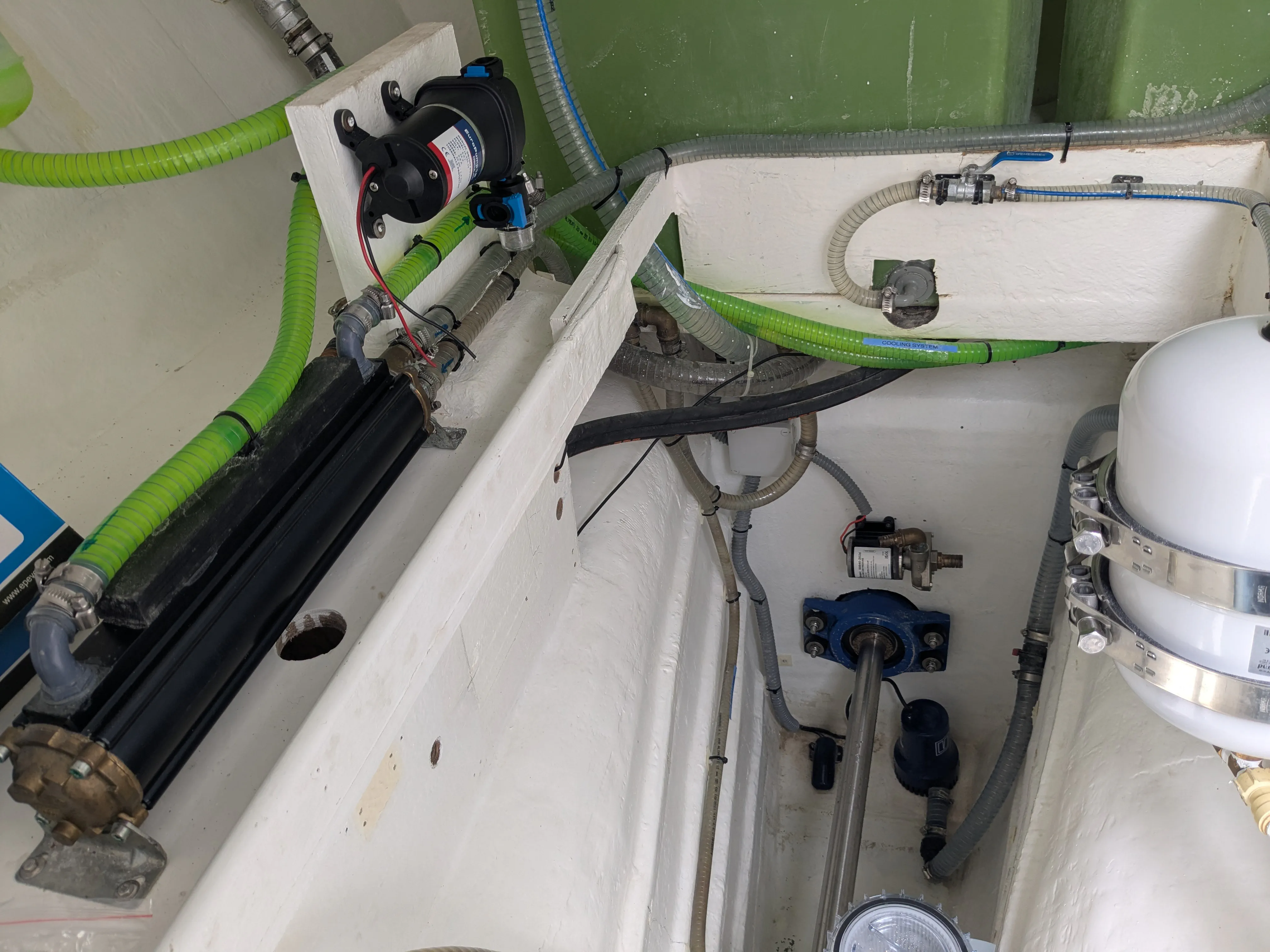
The starboard seawater pump—used to cool the electric motor and controller, which we had serviced in January, was showing signs of wear again. We had already purchased new pumps for both sides, so this stop was the perfect opportunity to install the new starboard raw water cooling circuit while waiting for the liferaft.
With the liferaft finally on board, we departed Marina Alicante in the early afternoon.
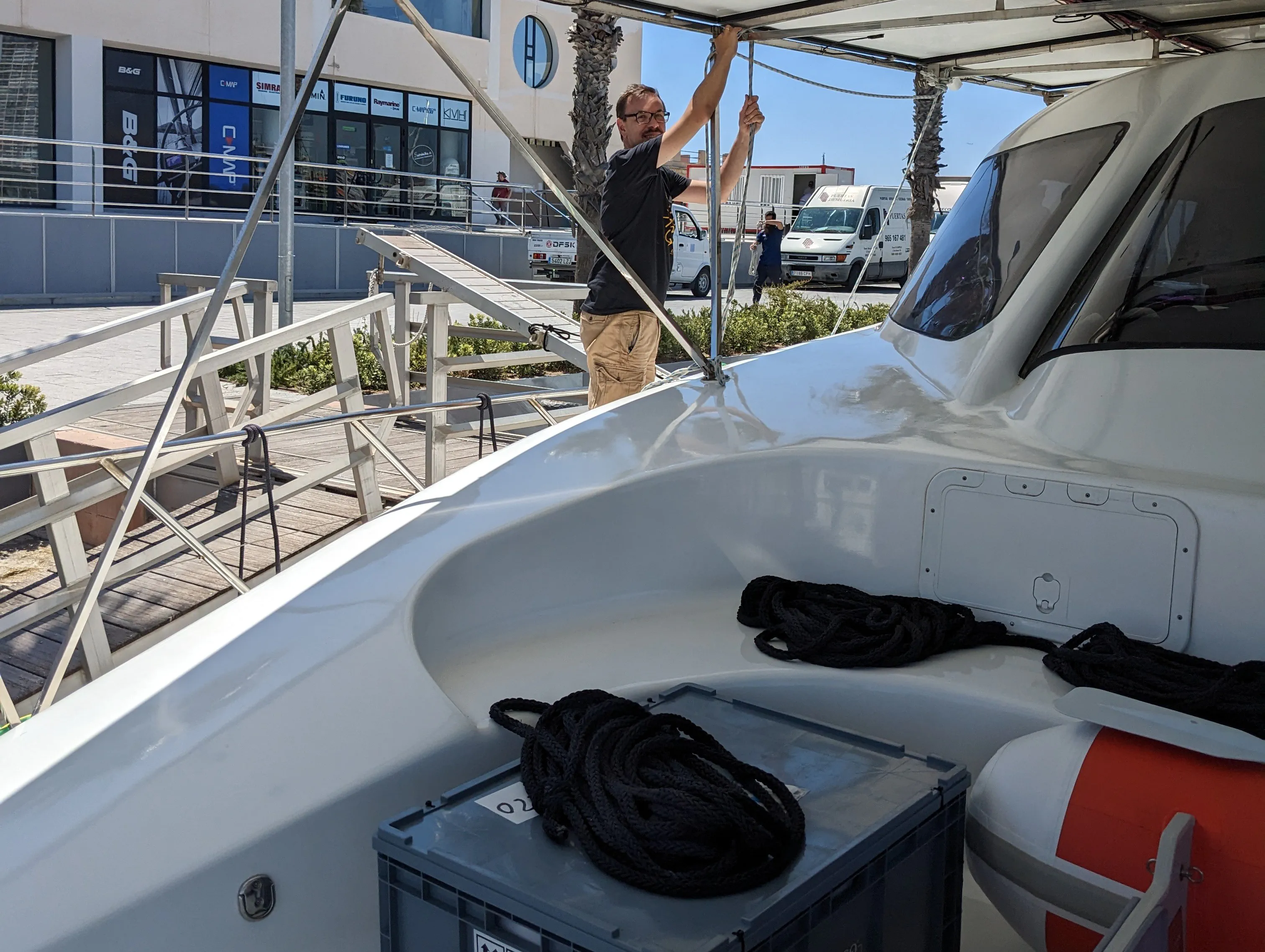
We left with a 99% SOC, aiming to pass Benidorm and find an anchorage for the night, as it was too late to reach Calpe before sunset.
We set our power to 24kW to maintain a steady 5 knots. Solar production was excellent, bringing our net consumption down to just 12kW. Although the starboard side was running on the new pump, we quickly realized the cooling was insufficient at 12kW per motor; the controller reached 65°C and the motor 56°C. We concluded the circuit needed a redesign, as too much sea water was being diverted to the dripless shaft seal instead of the heat exchanger. To manage temperatures for the rest of the day, we shifted more power to the port motor (still using the old pump) and reduced load on the starboard side.
Passing Benidorm was a striking experience. With its dense clusters of skyscrapers, it felt as though a local Las Vegas had been built on the Spanish Costa Blanca. It is a bit of a shame to see such massive development in an area of such natural beauty.
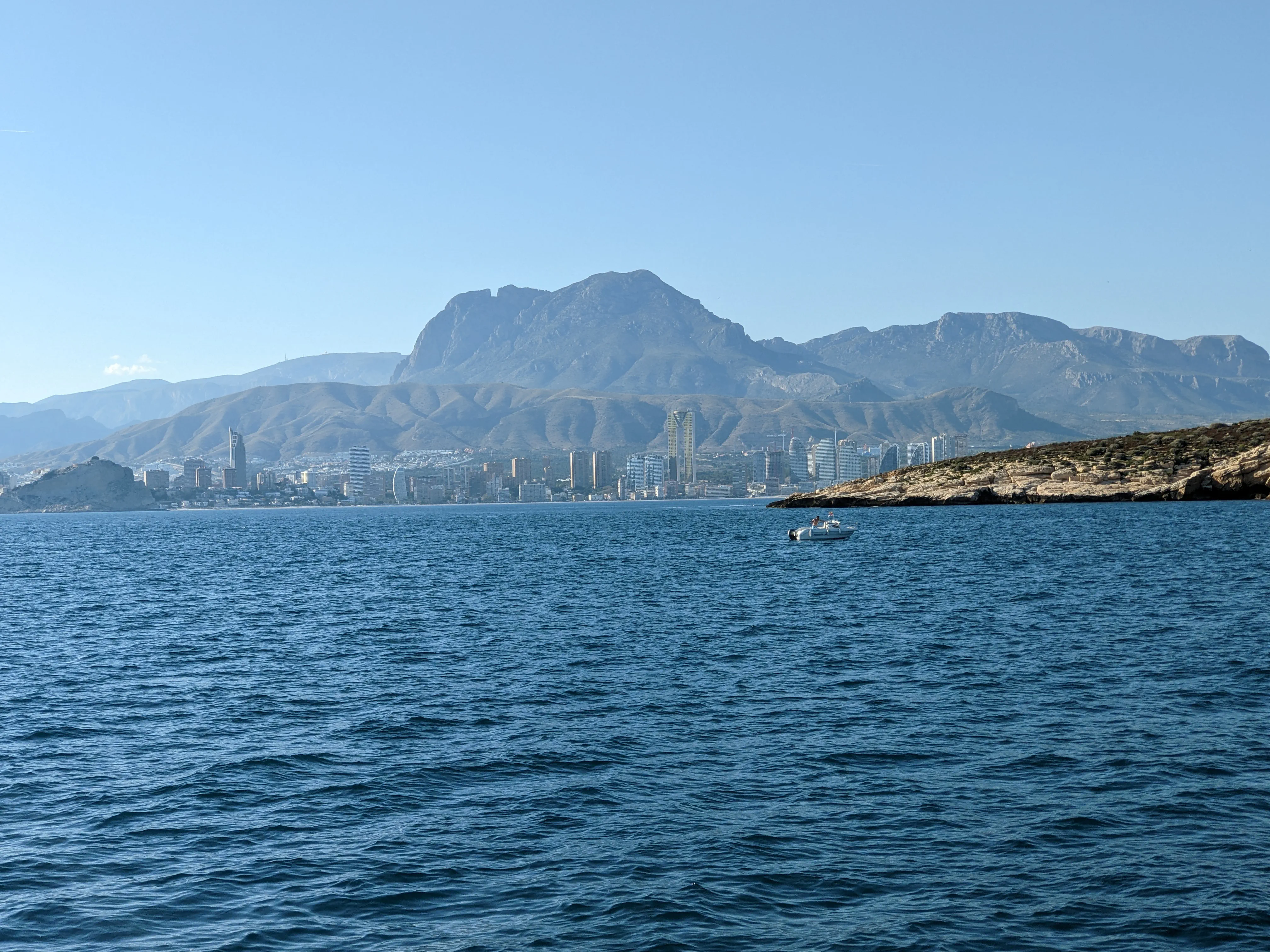
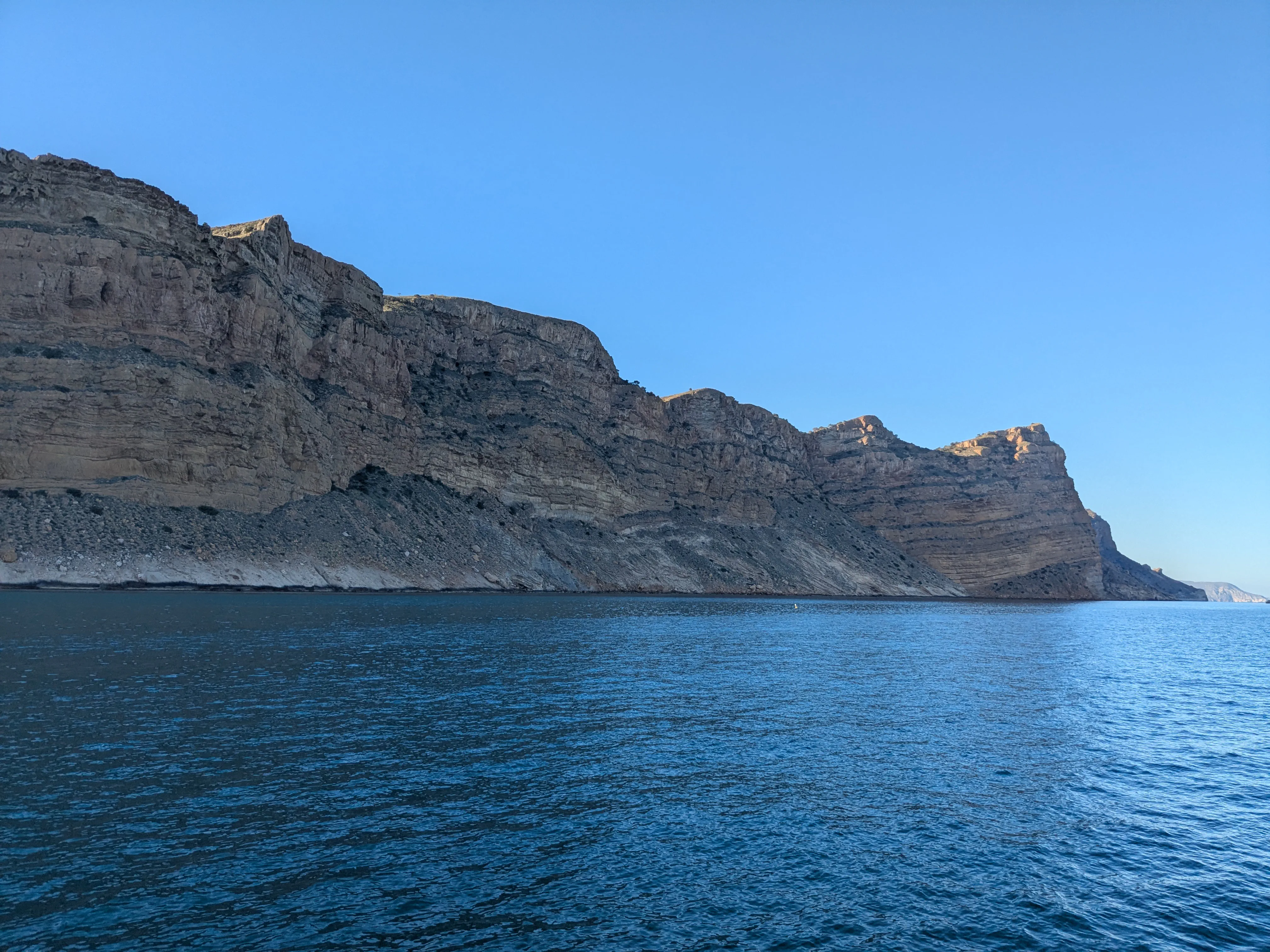
Continuing north brought the relief of the giant cliffs of Sierra Helada. With the sea perfectly calm, we stayed close to shore to fully appreciate the landscape. We slowed to 2.8 knots, consuming only 4kW, to try some fishing, though we didn’t get any bites that day.
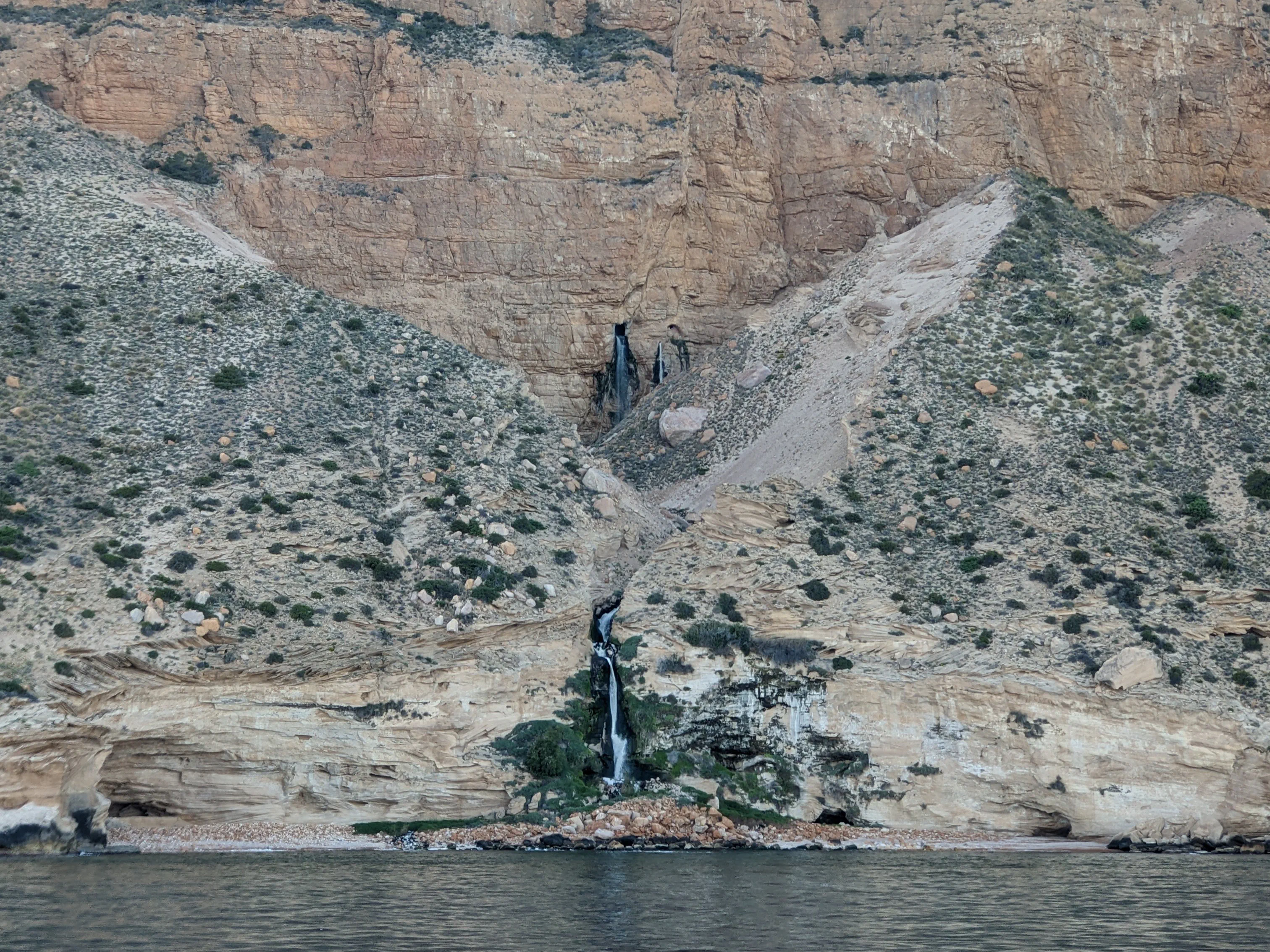
We spotted stunning waterfalls cascading directly into the sea from the cliffs. After some research, we discovered they were likely discharge from the sewage and desalination plants serving Benidorm, located atop the cliffs. Despite the source, the visual scene remained incredible.
We reached L’Albir at nightfall with 27% SOC and dropped anchor in 5 meters of water, our first time “on the hook” this season. As L’Albir is part of a natural reserve, we had to monitor our charts, depth sounder, and satellite maps carefully to find a safe spot, as the setting sun made it impossible to see the bottom.
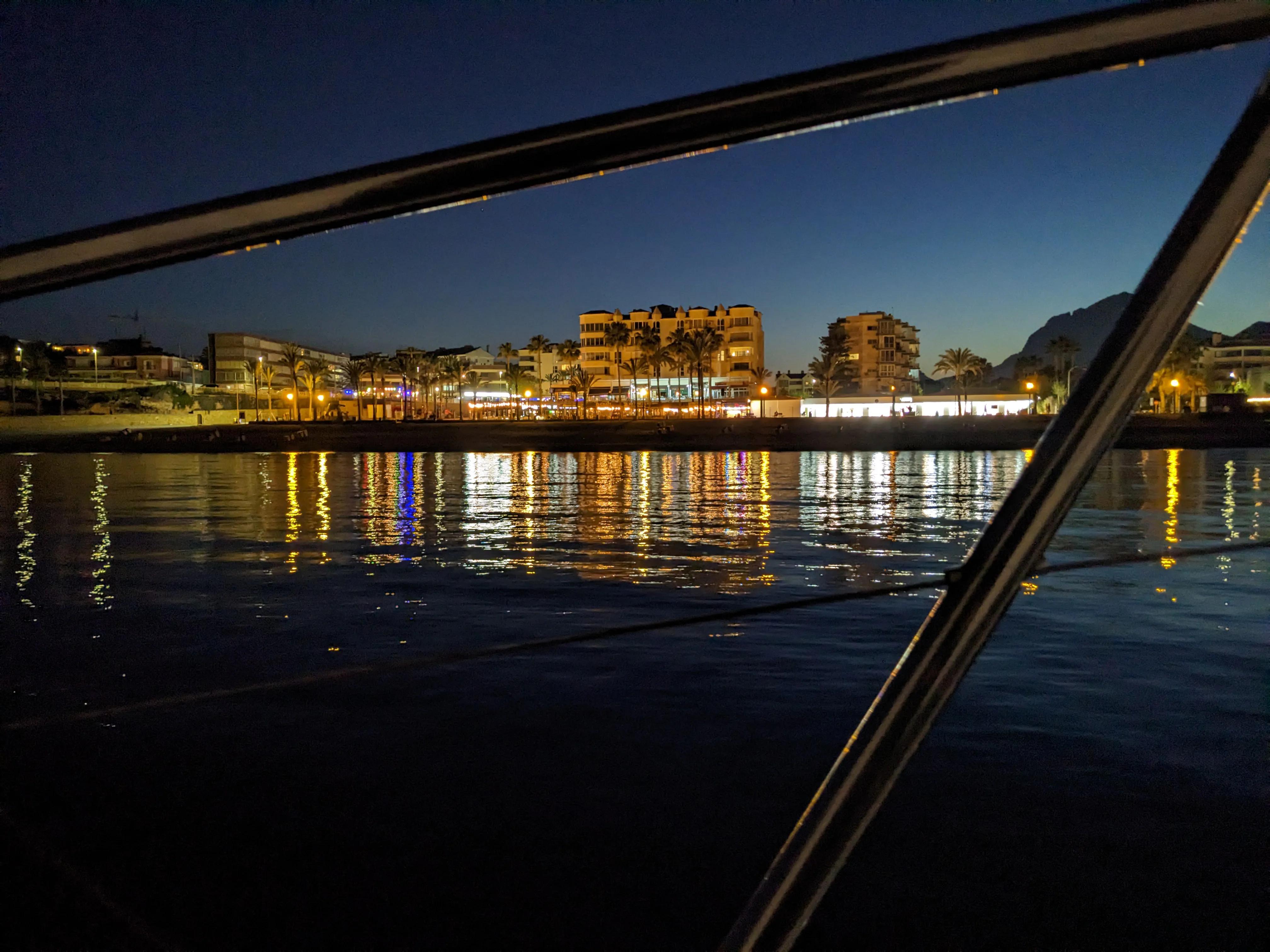
Our next stop was a reserved berth in Calpe, less than 10 nautical miles away. Given the short distance, we spent the morning swimming, cleaning the propellers, and taking BigBoy ashore for a walk.
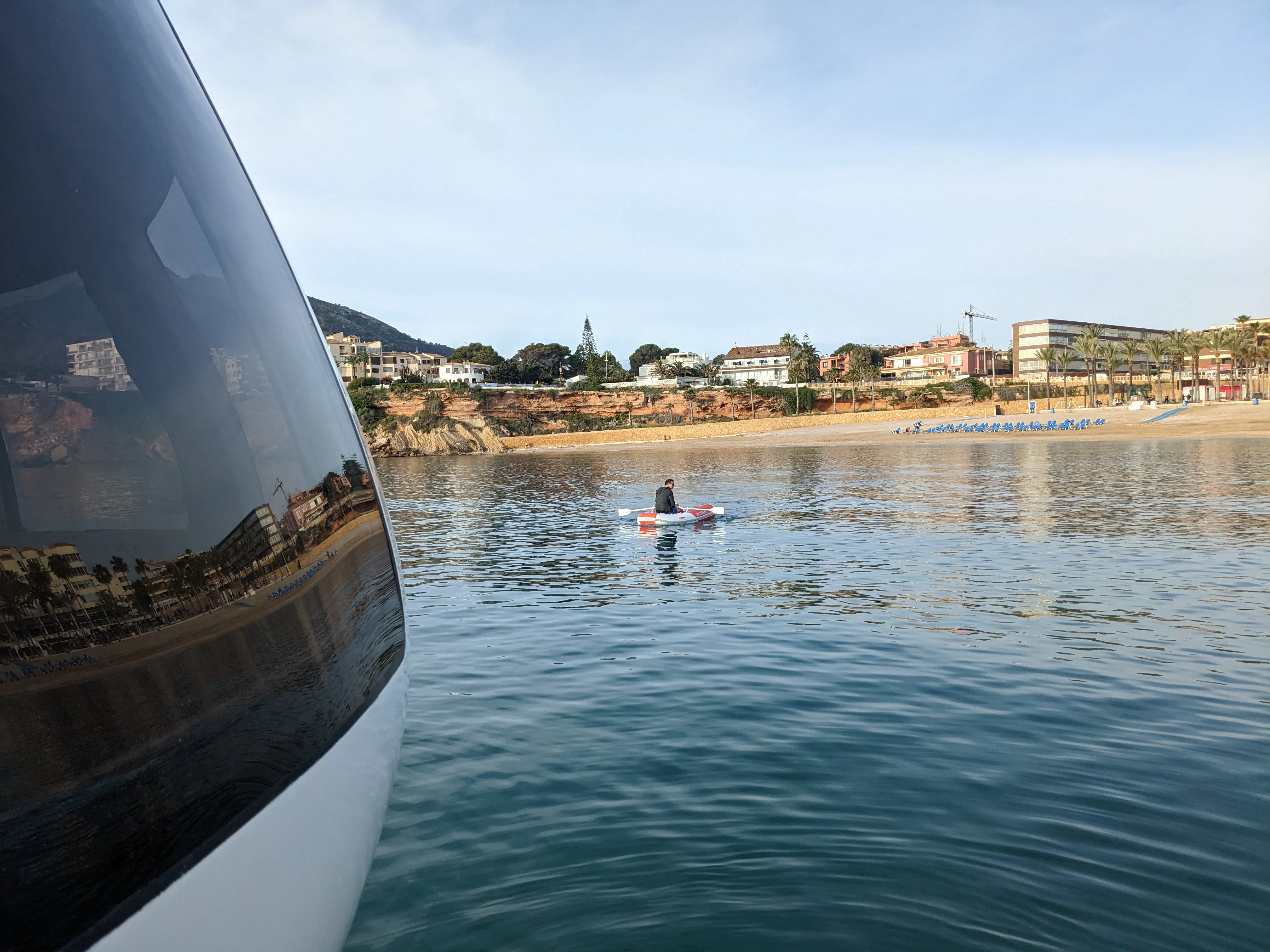
The morning sun partially recharged the batteries, allowing us to weigh anchor with 42% SOC. We set the propulsion to 10kW for a speed of 4 knots, resulting in a net consumption of 4.5kW.
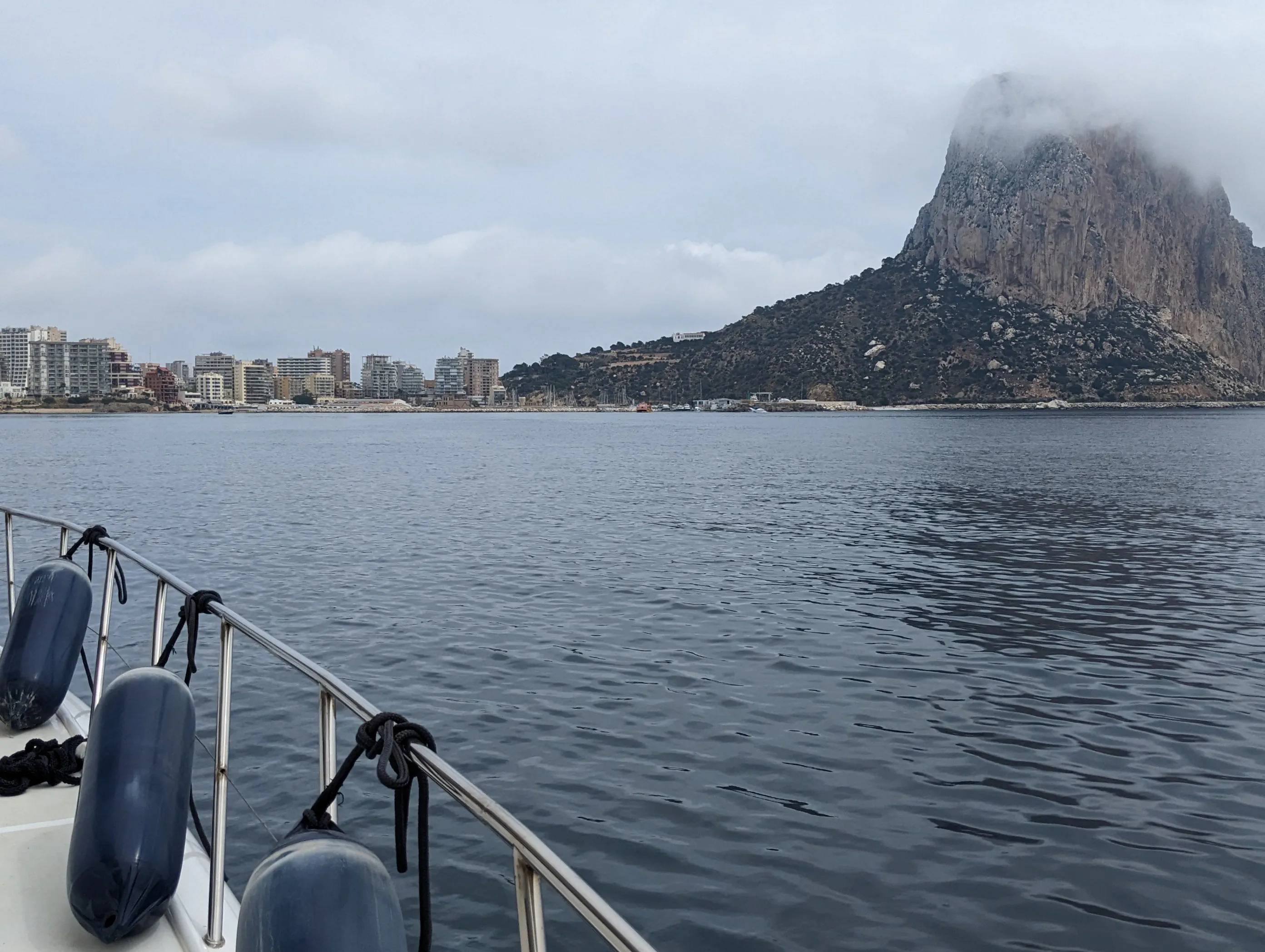
After two hours, we arrived at Calpe. The port is sheltered by the Peñón de Ifach, a massive limestone rock that serves as an unmistakable landmark.
Our visitor berth was at the end of a pontoon, which was slightly short for our 16-meter length. We docked with 36% SOC. Calpe remains an active fishing port, and we watched as boats returned followed by massive flocks of seagulls. Unfortunately, the gulls also took a liking to our large solar array as a place to rest and sunbathe.
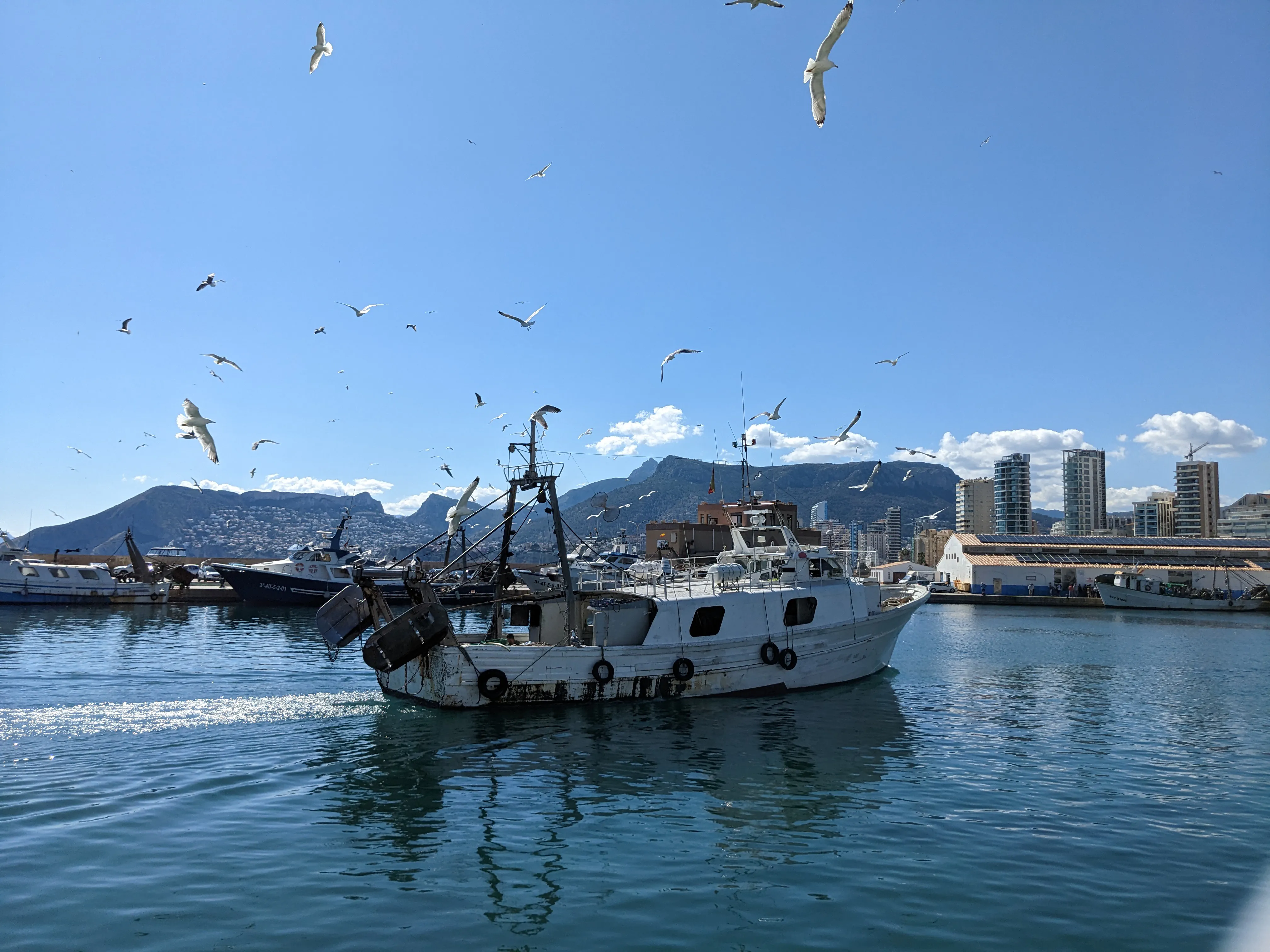
During our stay, we hiked the trail up the Ifach. The midpoint of the climb offers a spectacular view of the harbor and the coastline.
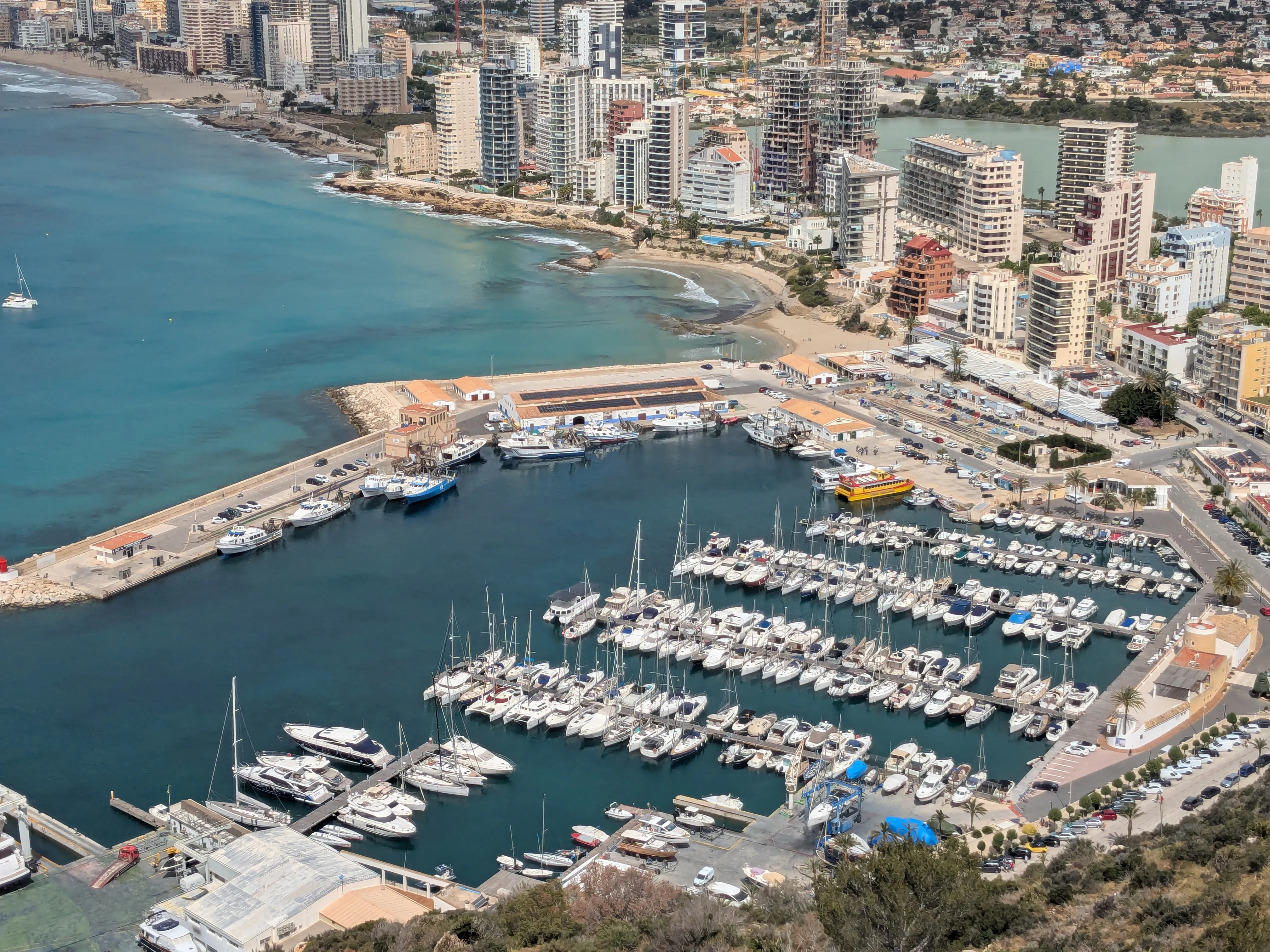
We also took this opportunity to rework the starboard cooling system, routing the seawater through the heat exchanger first before sending a portion to the dripless shaft seal for lubrication.
We stayed in Calpe longer than planned. While we originally intended to cross directly to Ibiza, weather windows were tight, and the anchorages on Ibiza’s west coast were forecasted to be exposed. We contacted several marinas on the island, but none would offer guaranteed reservations, advising us instead to call at noon on our day of arrival. Furthermore, the visitor rates were prohibitive, more than four times what we usually paid on the mainland. We decided not to rush and moved to Denia to wait for better conditions.
We left the dock with 99% SOC for the short 21-nautical-mile trip.
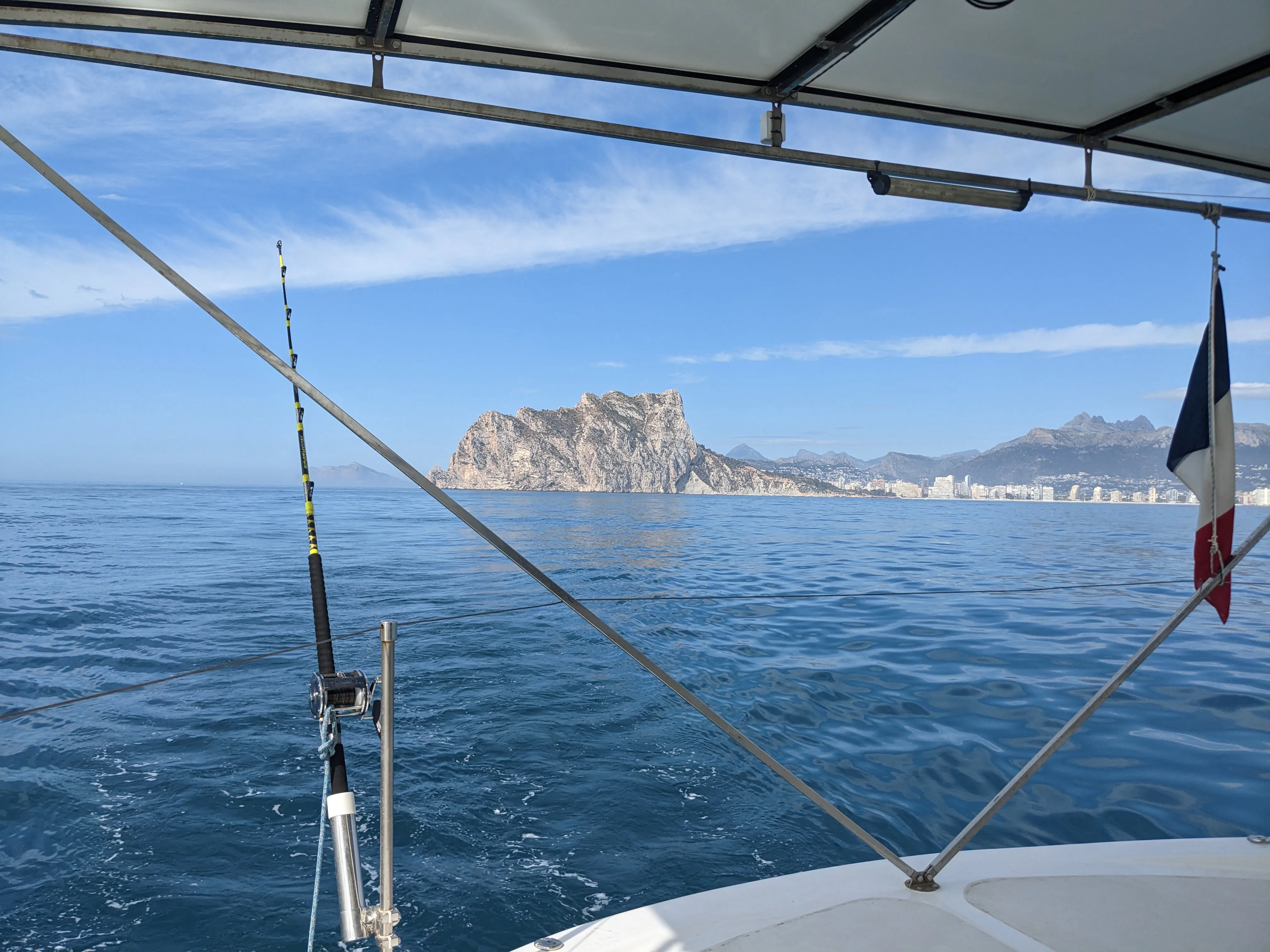
We passed Moraira at 4 knots with 10kW of power. The coastline here is stunning. As is common when approaching capes, we hit stronger currents near Cape Negre and Cape de la Nau, requiring us to increase power to 25kW to maintain 5 knots.
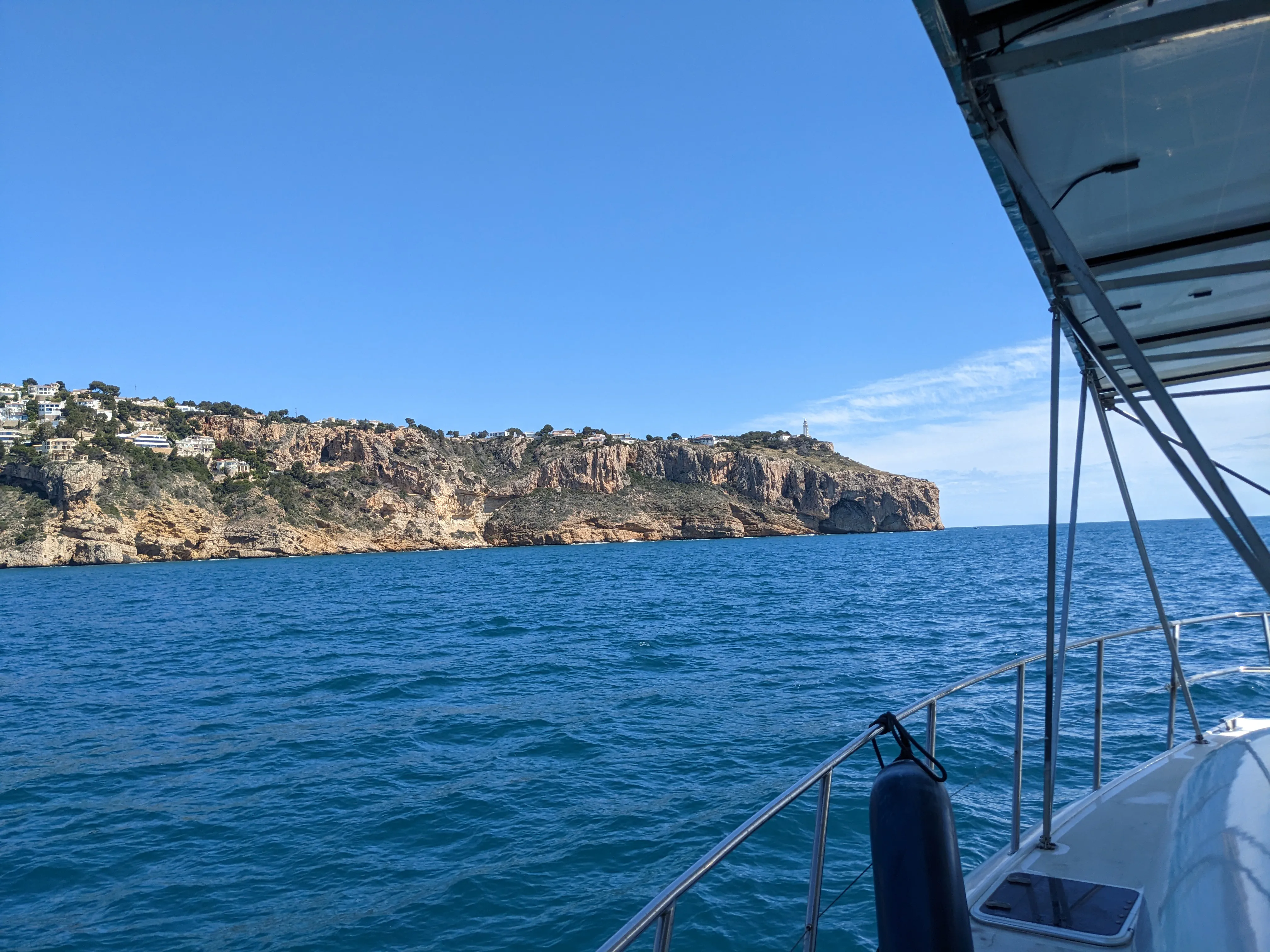
We reached Marina de Denia with 68% SOC remaining after a sunny trip around the peninsula. Denia is a charming city to explore, featuring an 11th-century Islamic castle situated on a 60-meter-high hill in the city center.
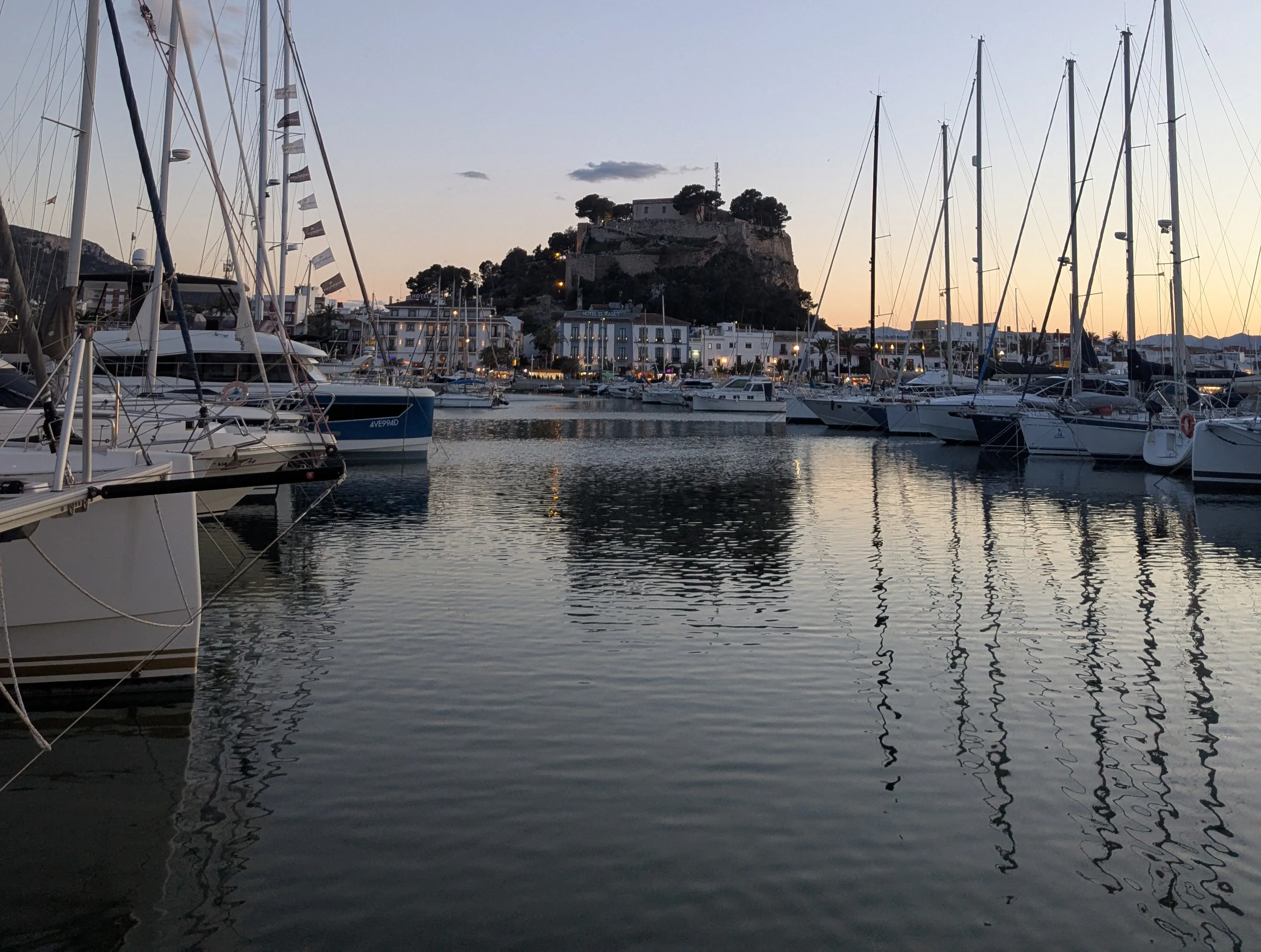
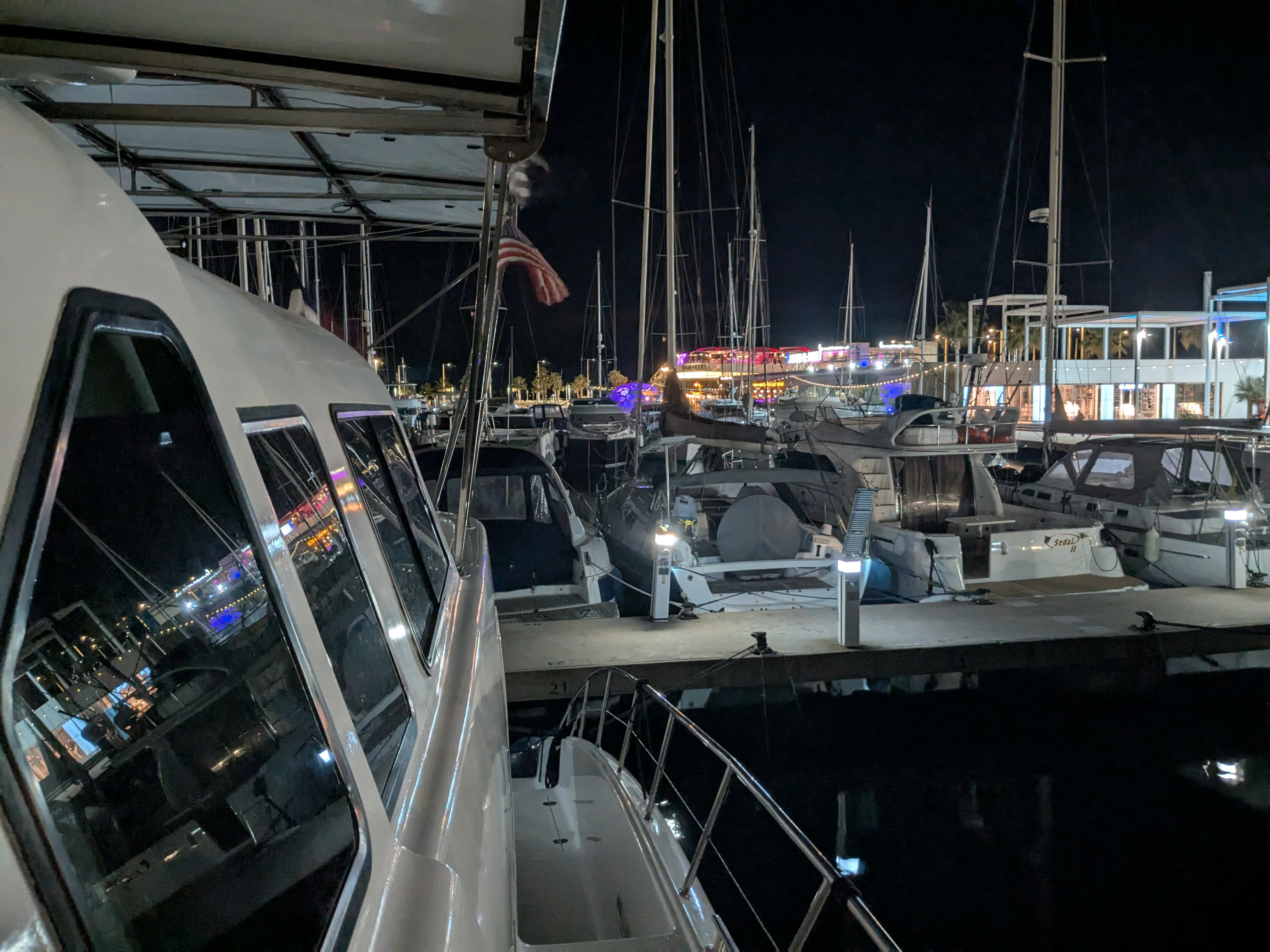
The day for our first crossing finally arrived. We expected gentle conditions: winds under 10 knots and waves of roughly 0.5 meters on the bow. We anticipated finding good shelter on Ibiza’s west coast after the 52-nautical-mile passage.
We departed at 6:15 AM with 98% SOC and our navigation lights on, carefully avoiding dredging activity in the harbor.
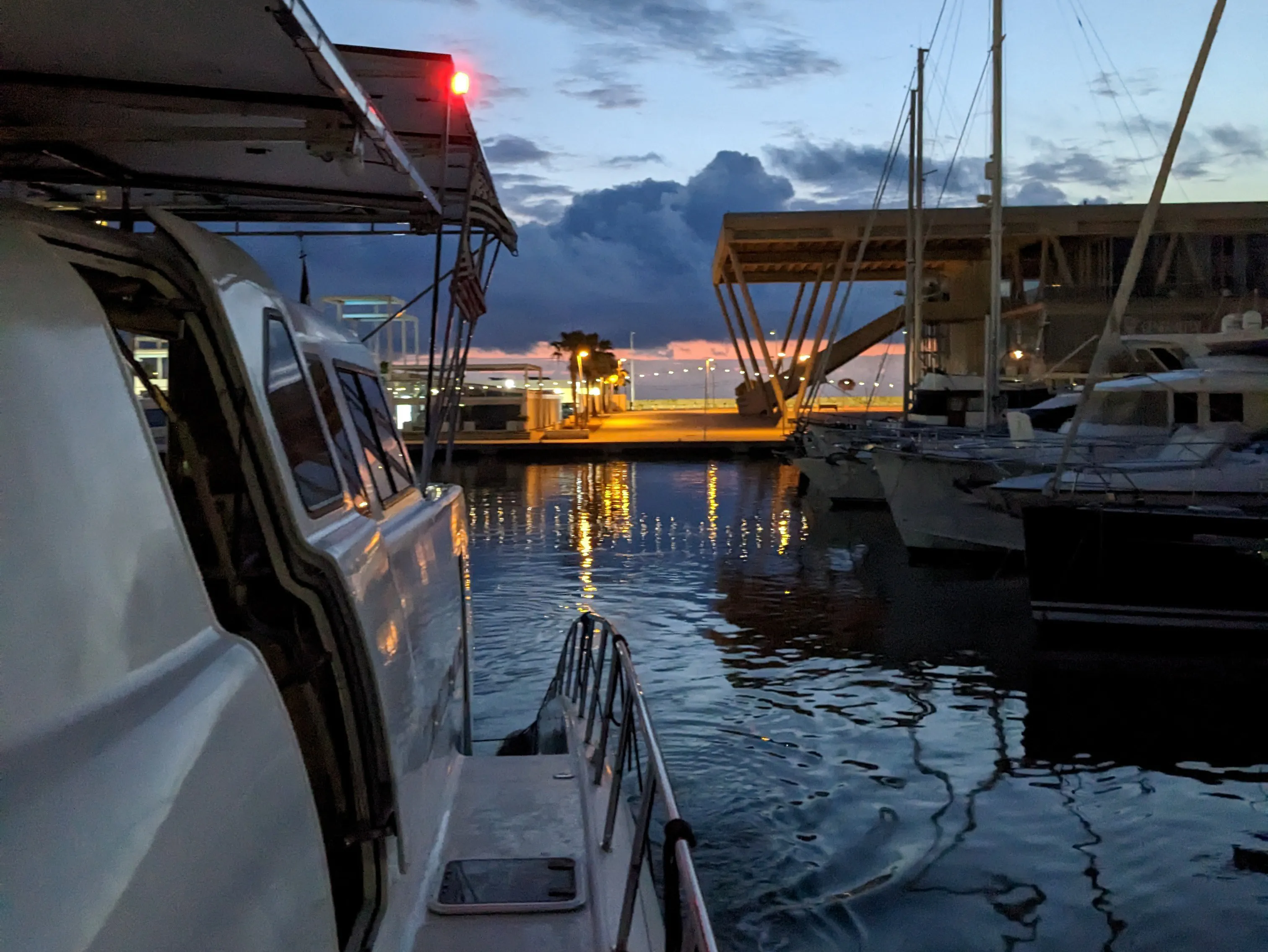
Initially, we set the propulsion to 10kW to stay above 4 knots. The sea state was messy for the first few hours, with cross-swells causing some rolling. Eventually, the waves aligned with our bow, making the ride much more comfortable.
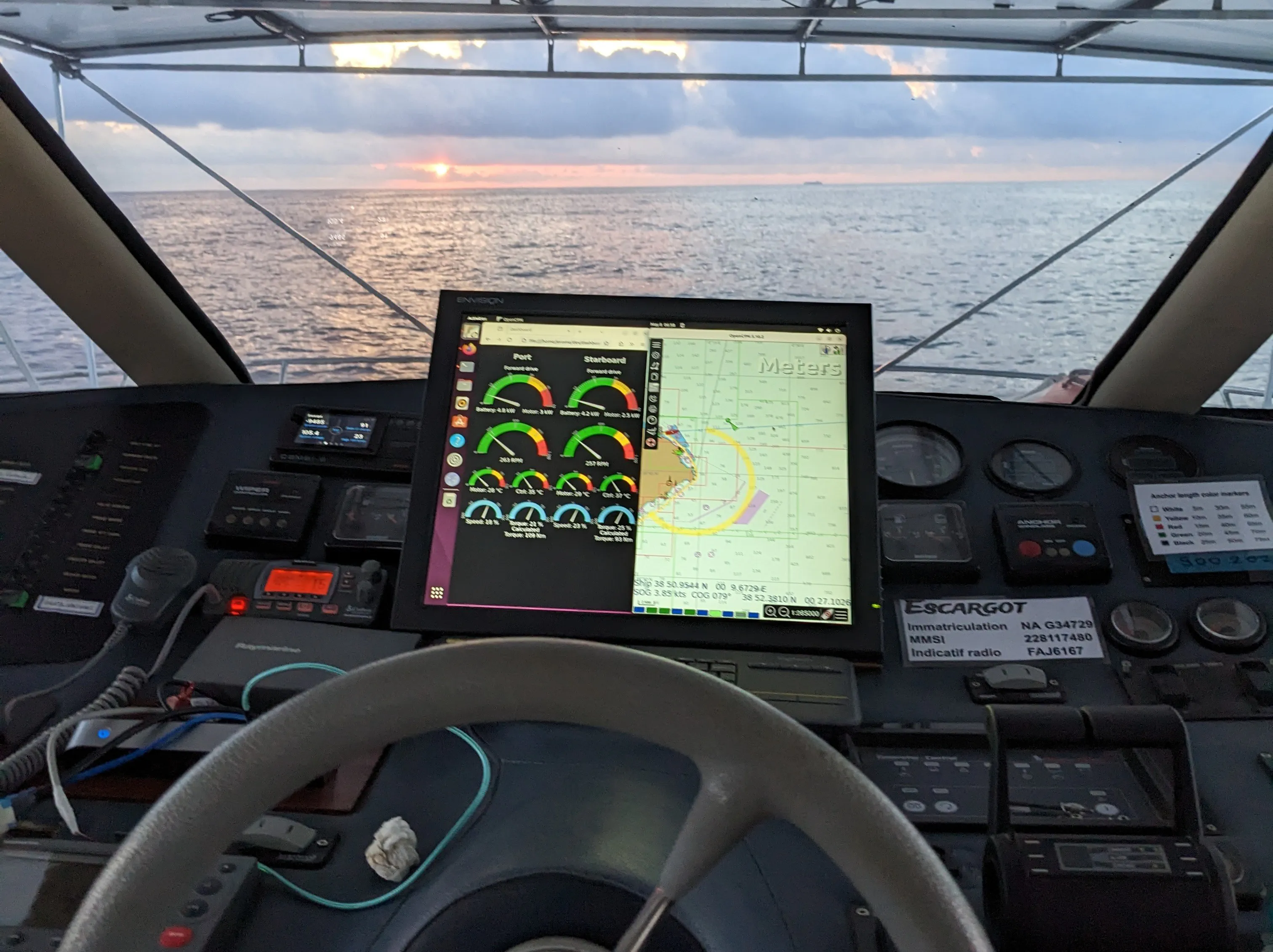
Five hours in, we noticed we were consuming more power than expected due to the head seas, and solar generation was weaker than forecasted. Updates also suggested our intended anchorage would be uncomfortable due to incoming swells. We decided to divert toward Sant Antoni de Portmany to find better protection. This added 5 nautical miles to our day, so we ran the backup generator for three hours and increased speed to 5 knots at 20kW.
We were pleased to see the updated starboard cooling system performing perfectly at 10kW. Since electric propulsion is roughly 85% efficient, the system was successfully dissipating about 1.5kW of heat into the seawater. We now had a proven template for the port side. After three hours of generator time, we returned to silent sailing as Ibiza appeared on the horizon.
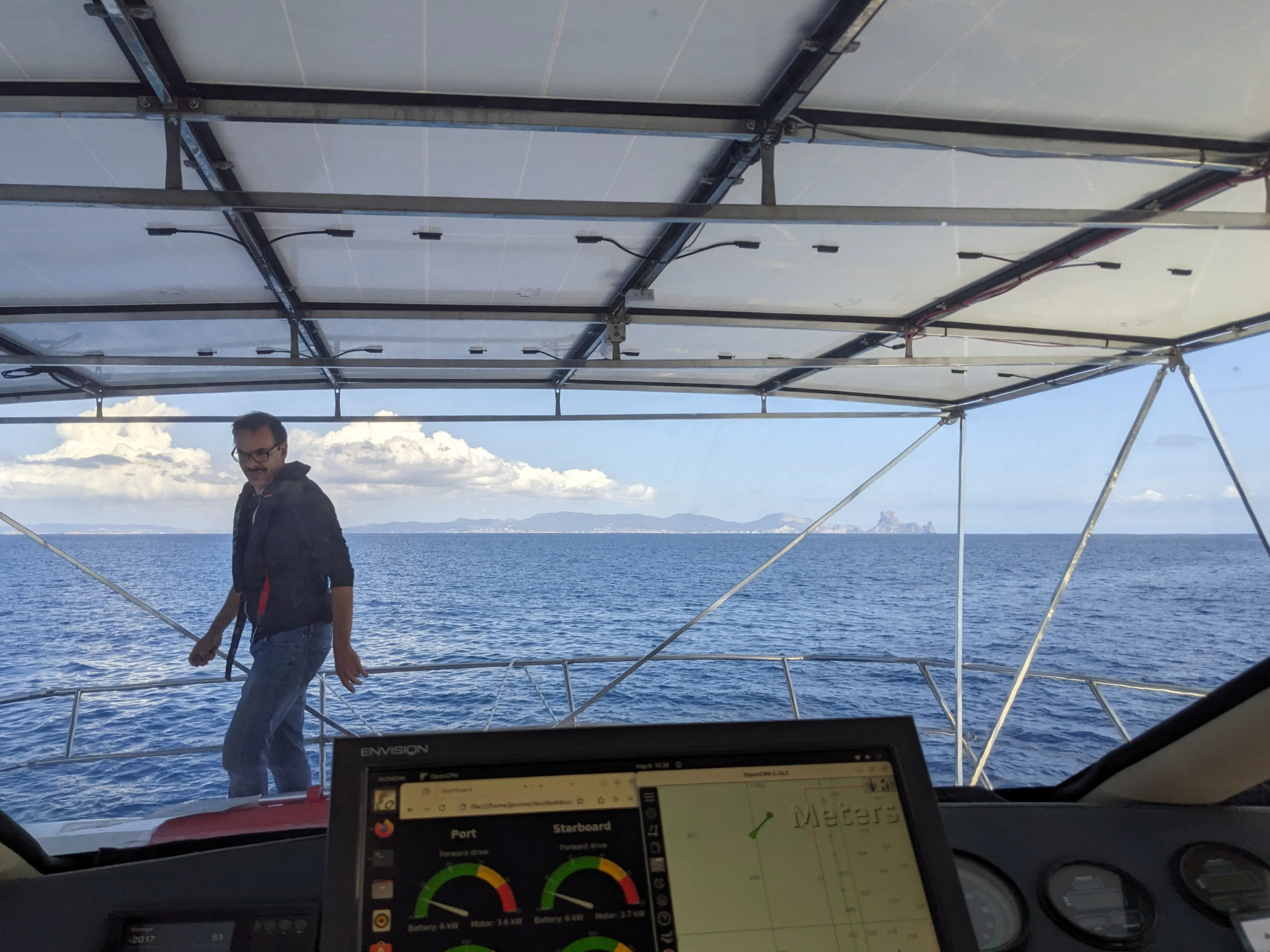
We navigated carefully between the rocks of Es Picatxos, monitoring our depth visually and via instruments, as the charts showed only 2 meters at low tide.
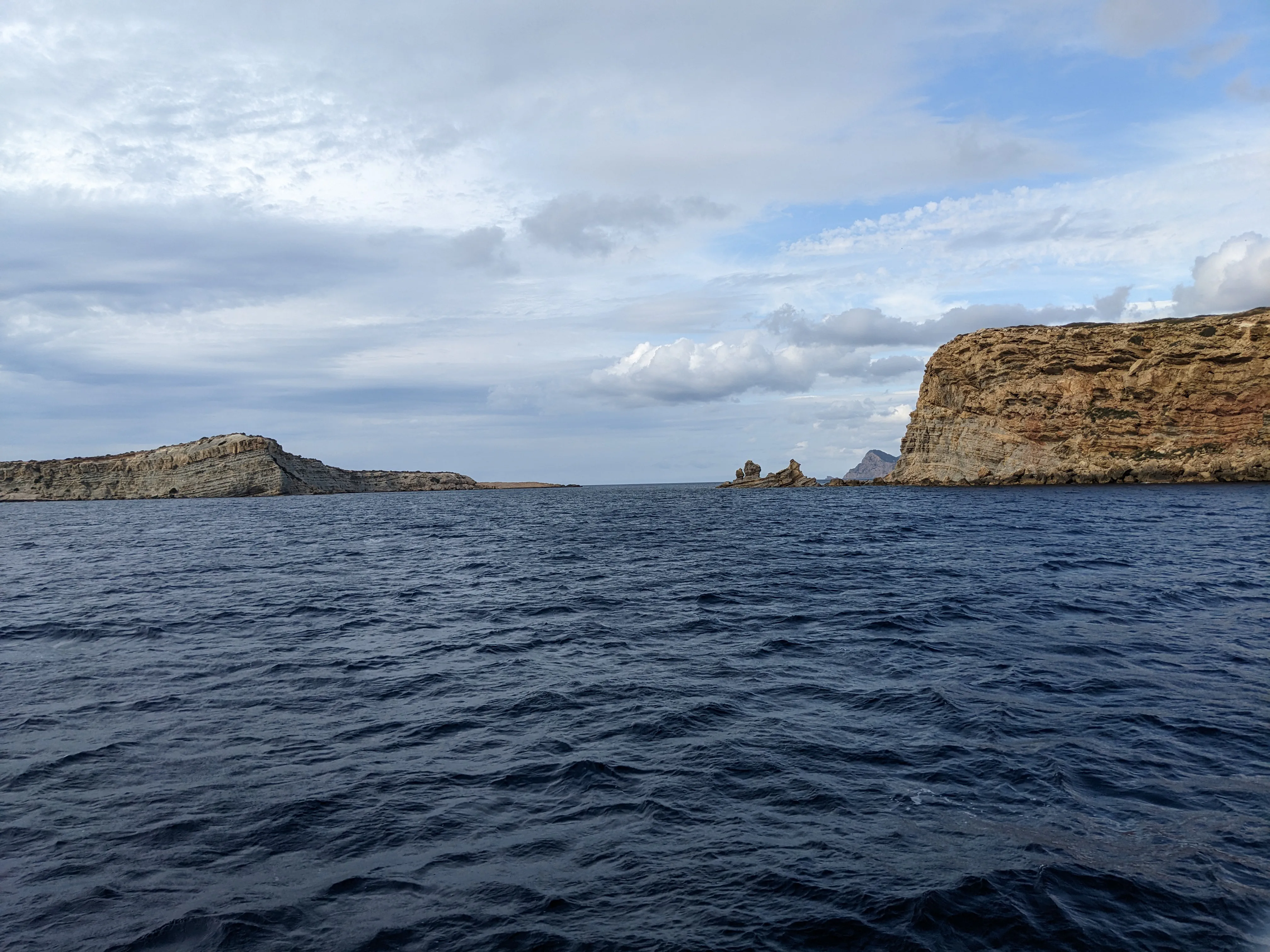
After 13 hours, we dropped anchor in 8 meters of water on a sandy patch with 30% energy remaining. We realized we could have made the crossing without the generator if we had slowed down and arrived two hours later with 10% SOC.
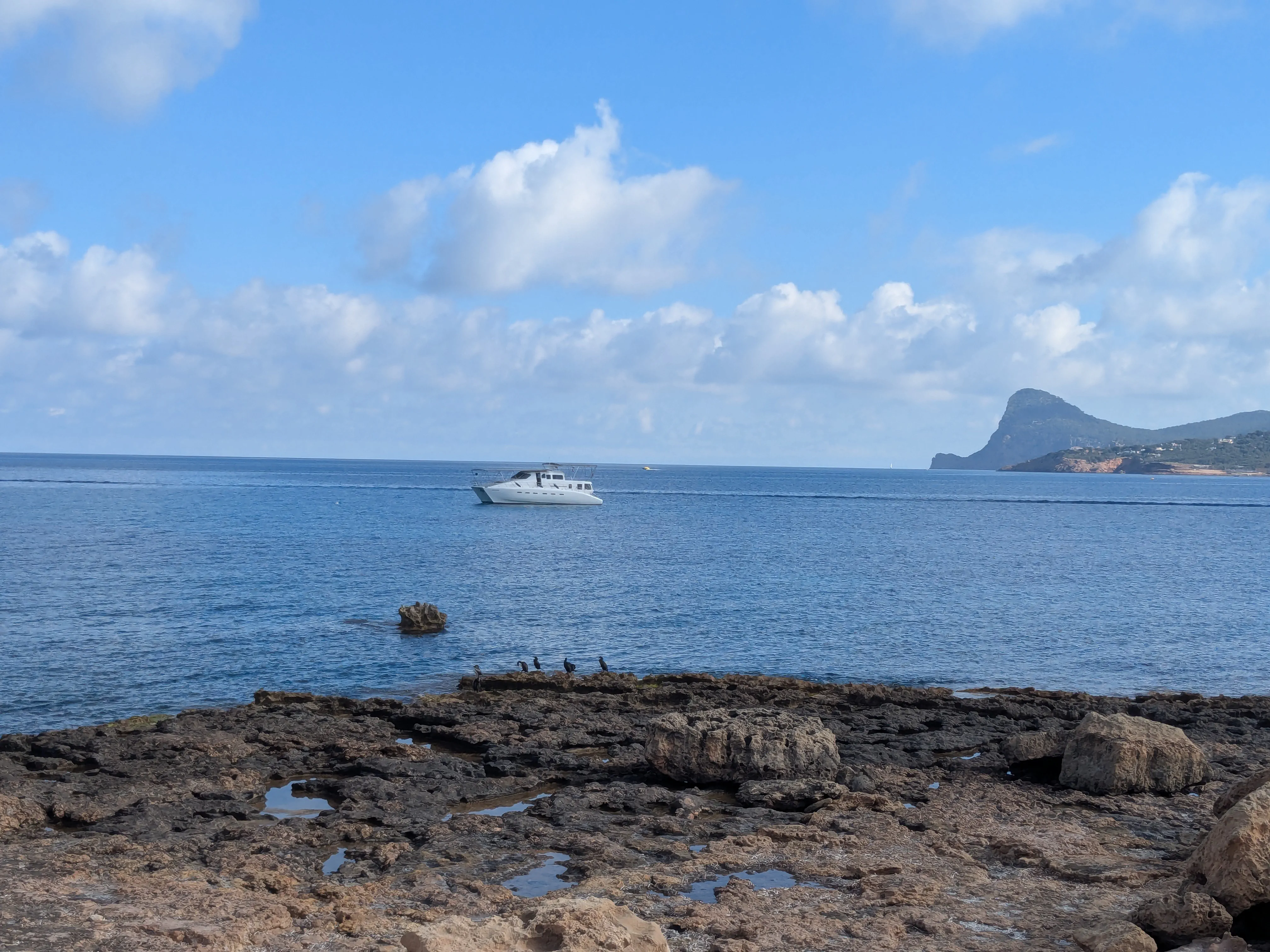
BigBoy was thrilled to get ashore after our longest crossing yet. We spent several peaceful nights there, enjoying incredible sunsets.
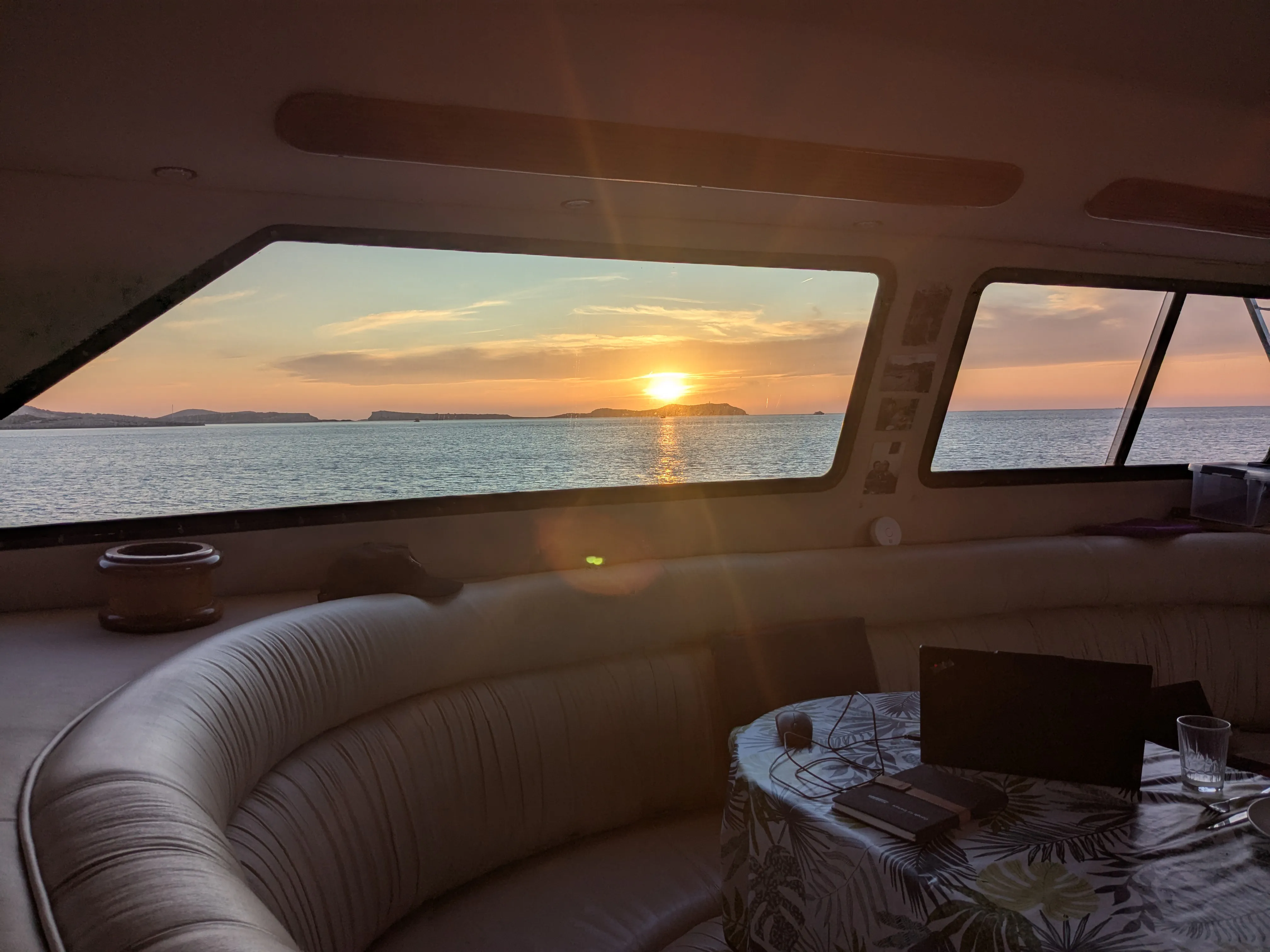
While the area was beautiful, the local “nautical life” involved many rental boats and jet skis ignoring the 5-knot speed limit. Seeking more tranquility, we decided to head for Formentera.
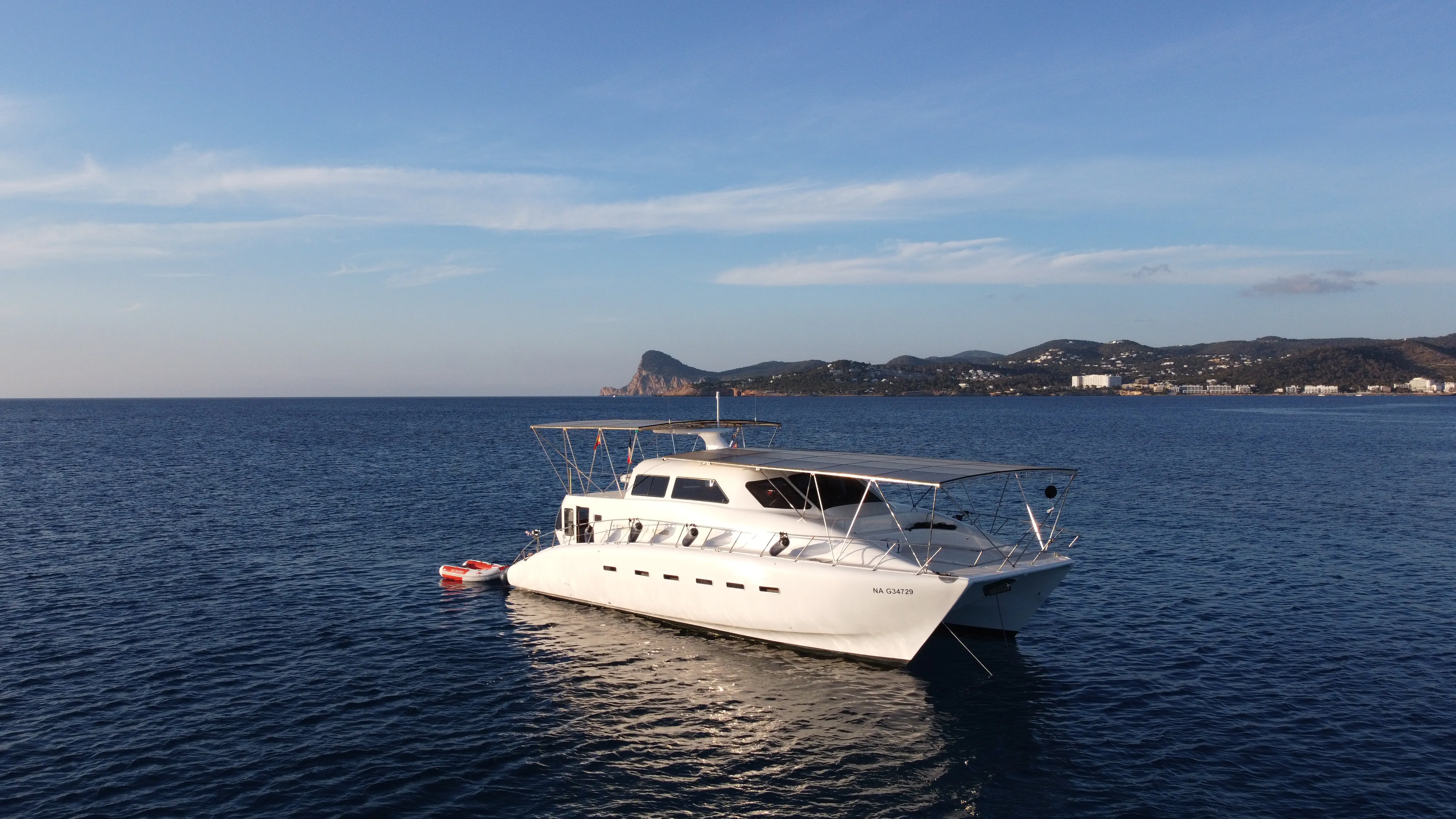
We weighed anchor mid-morning with 100% SOC. Our plan was to round the south of Ibiza and cross to Formentera, following its east coast to Es Pujols.
On the way, we spotted some impressive vessels, including the golden superyacht Khalilah, whose unique hull design makes it resemble a trimaran.
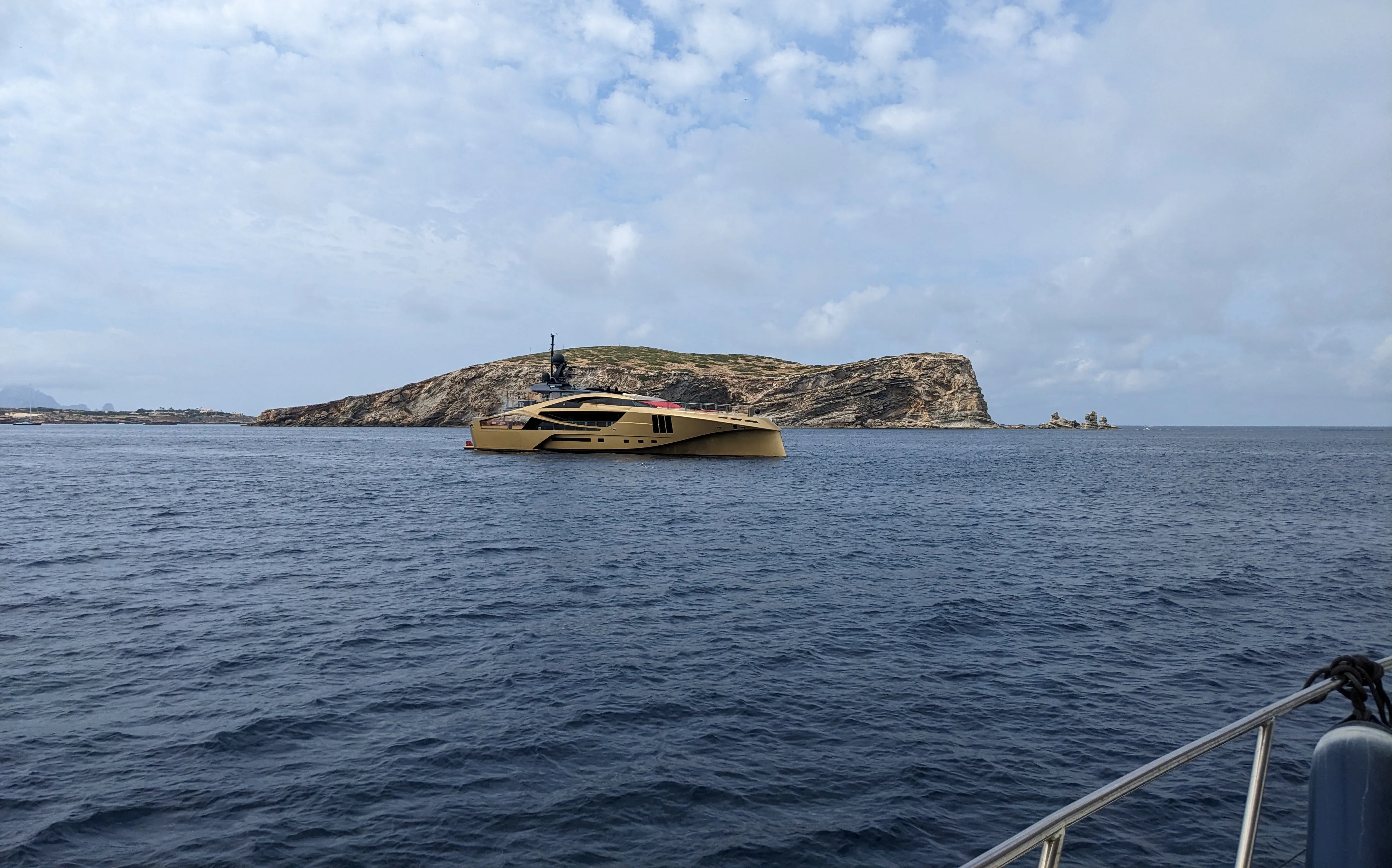
The sea was calm as we headed south. Aided by a favorable current, we reached 5.5 knots on just 11kW. Turning east, the waves began pushing us from behind; we synchronized our speed with the swell, consuming 16kW to maintain a comfortable 5 knots.
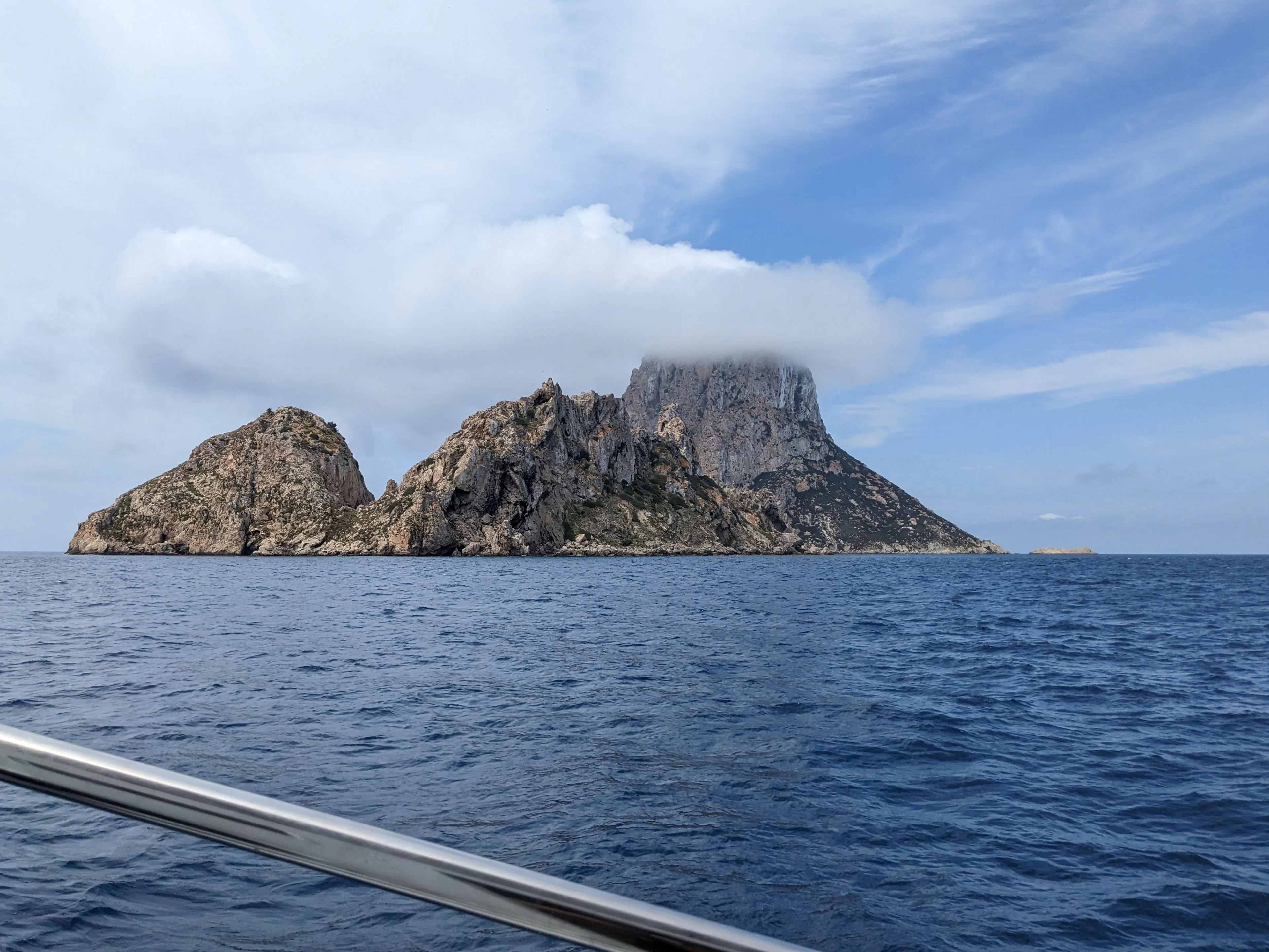
We crossed between the southern tip of Ibiza and northern Formentera, passing Cabo Falcò. We made a quick detour to wave at friends on the catamaran YOLO before continuing to Es Pujols at a leisurely 3.5 knots.
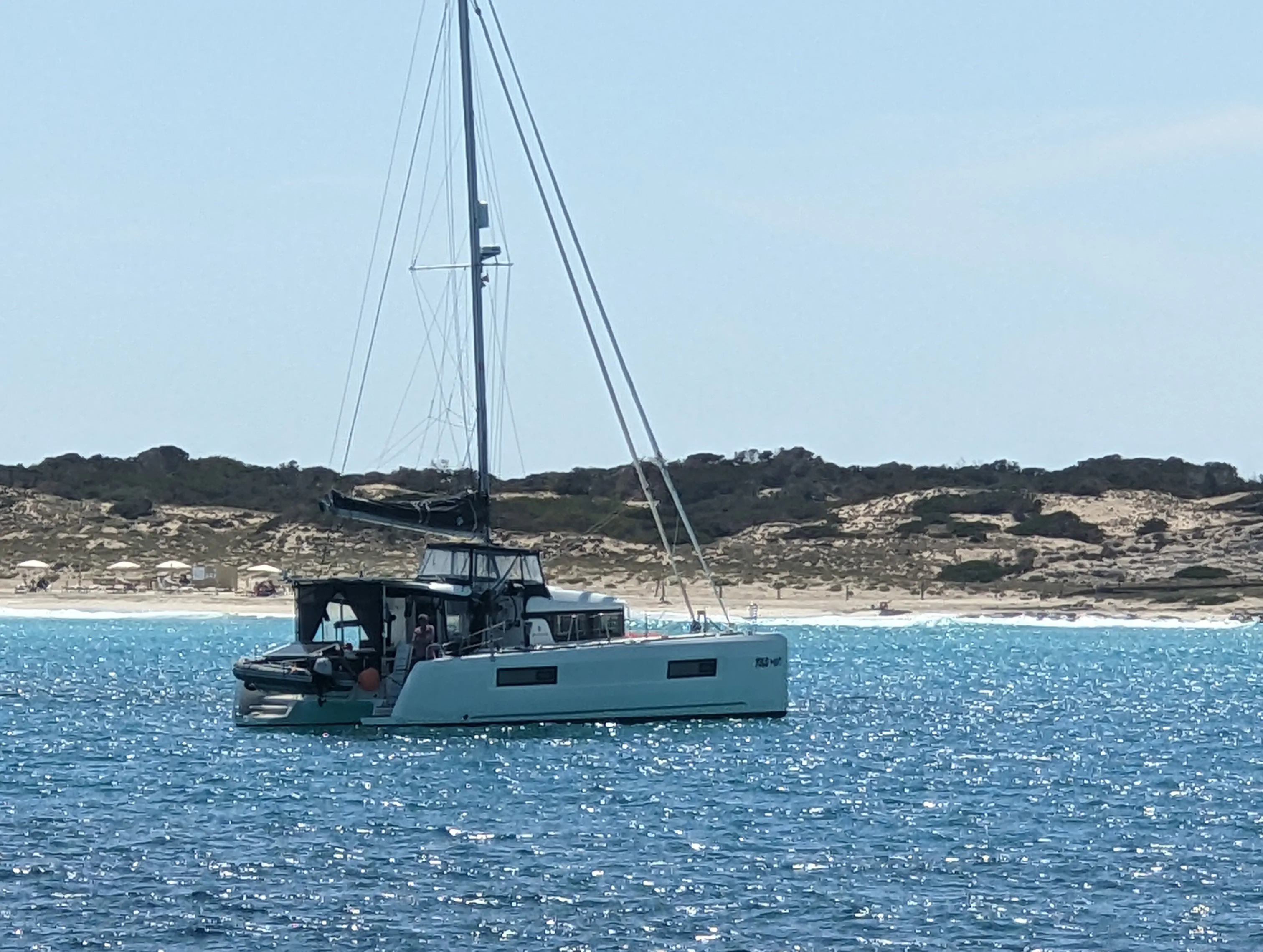
At this pace, we were actually generating more energy than we consumed. We anchored in 10 meters of water with 83% SOC.
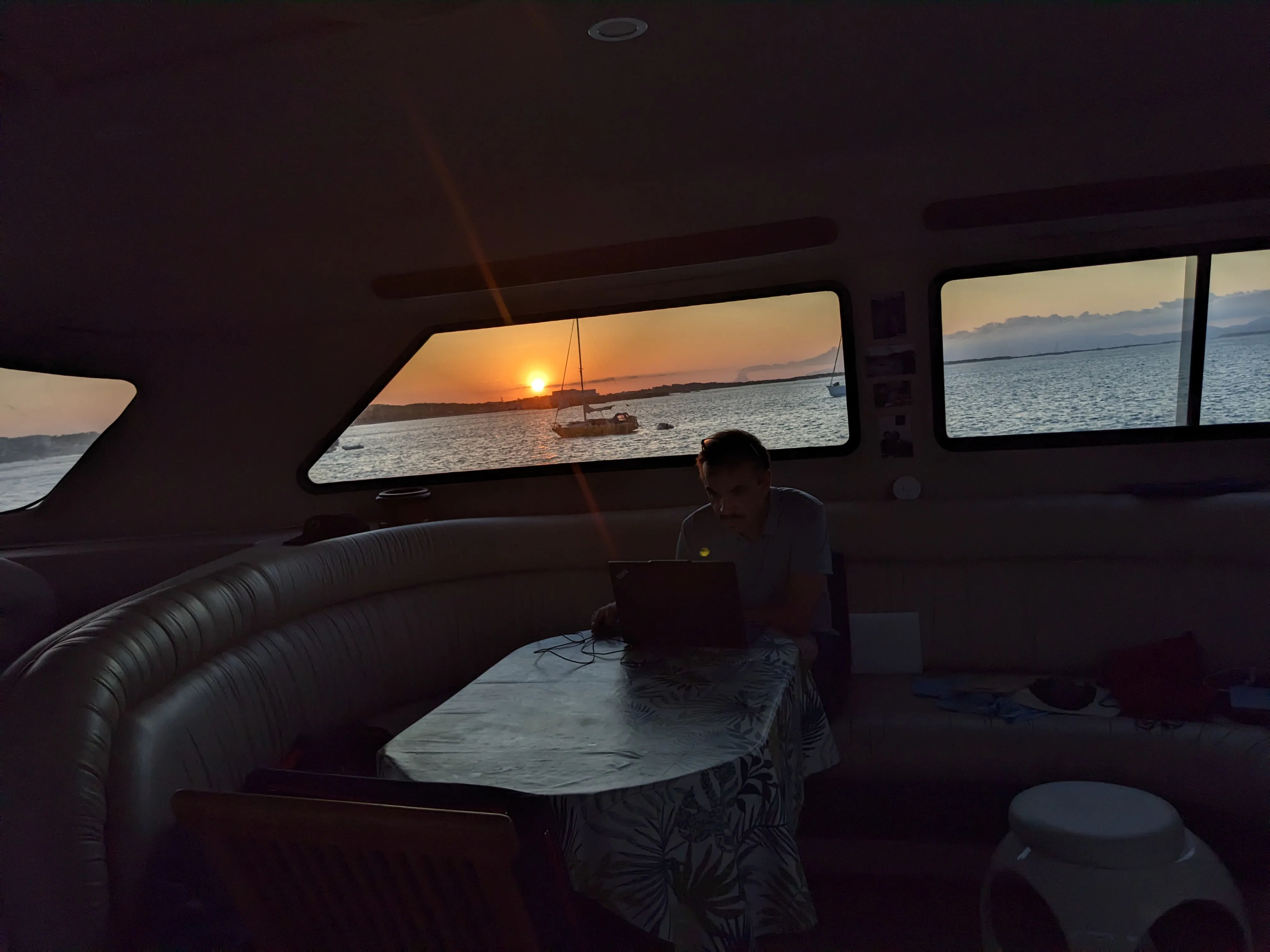
The east side of Formentera was much quieter. Aside from a few large motor yachts, the area was incredibly peaceful.
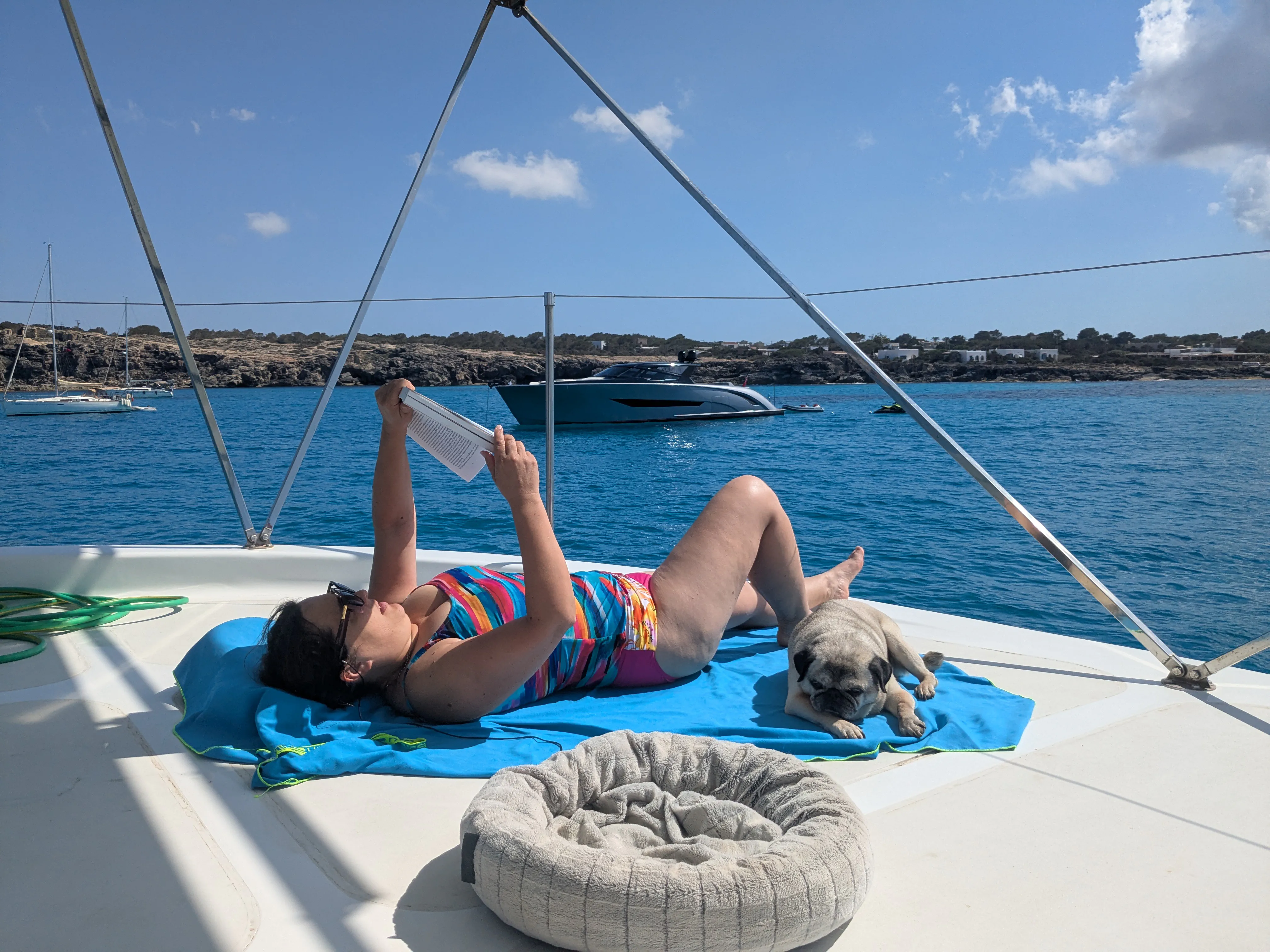
We spent two nights there, but with thunderstorms and swells forecasted, we began looking for a more secure refuge.
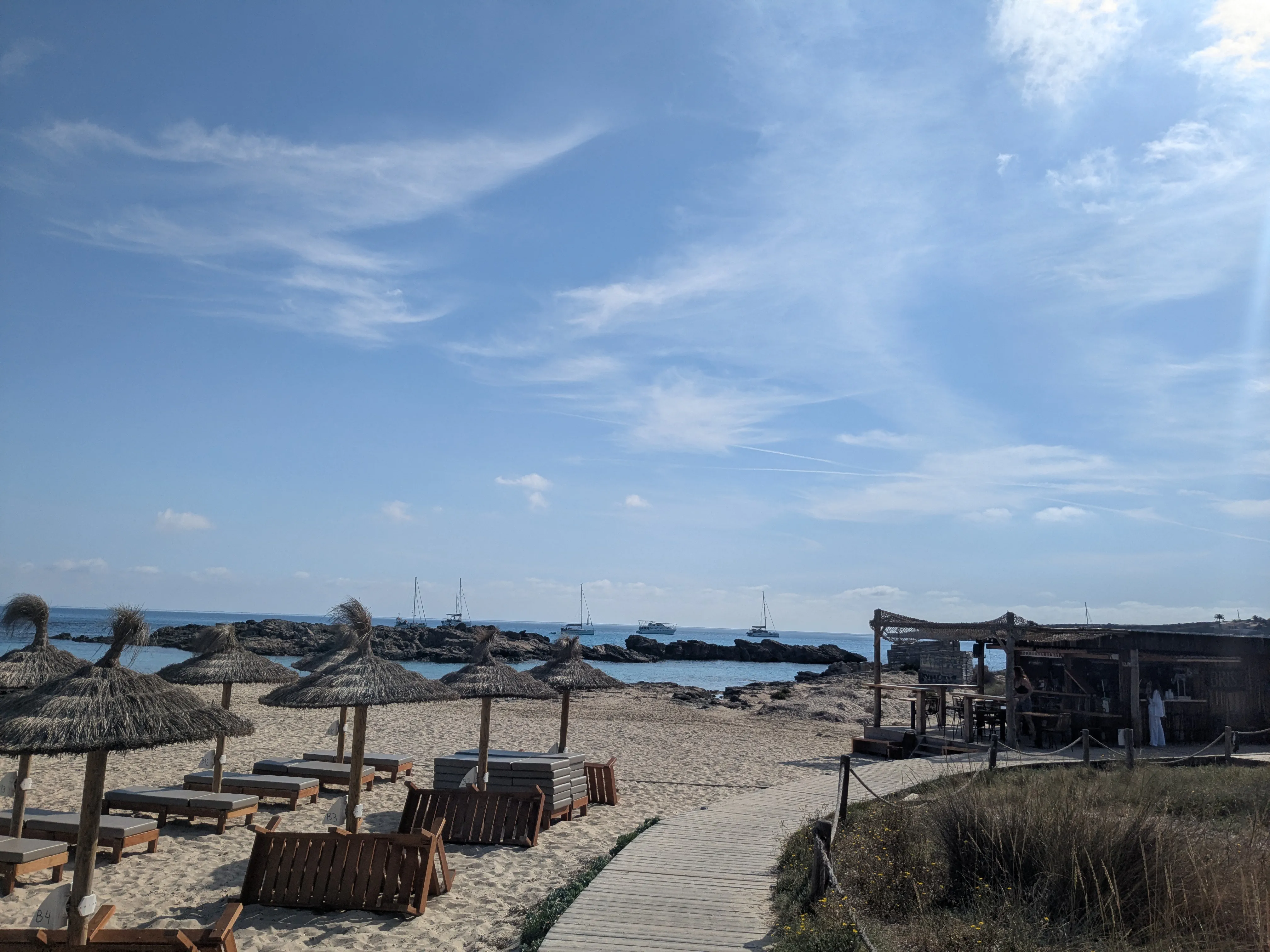
We booked a few nights at Marina Port Formentera (La Savina) to shelter from the storm and refill our water tanks. We decided to take the scenic route, circumnavigating the entire island to see its natural coastline. We left Es Pujols with 99% SOC.
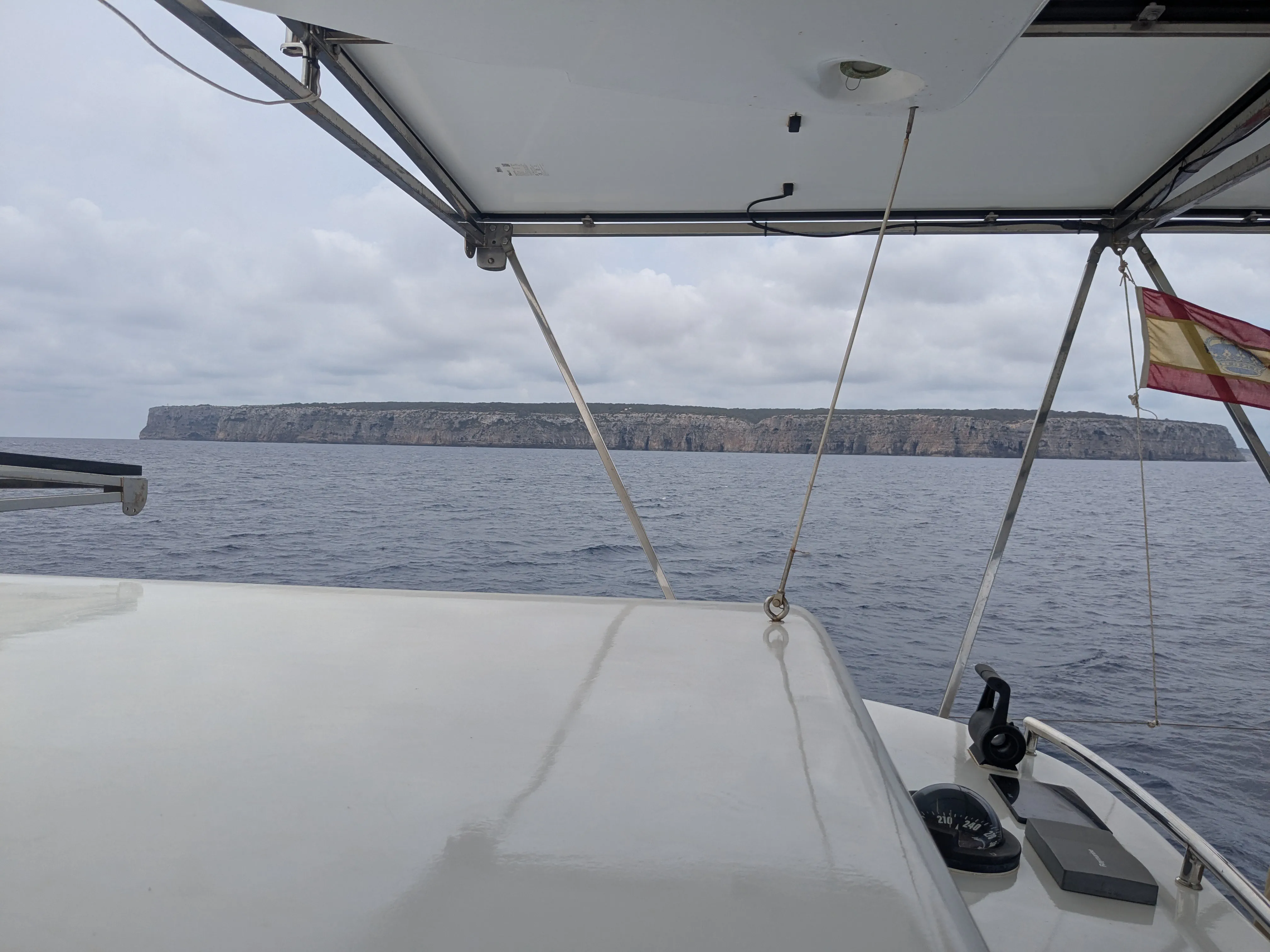
The trip began with sunny skies and positive net energy generation. However, as we approached Punta de sa Creu, the sky turned overcast, and we shifted to a net consumption of 6.5kW. Rounding the southern part of the island, a 1-meter beam swell made the boat roll uncomfortably. We had to tack to keep the waves on our quarter or bow to stabilize the ride.
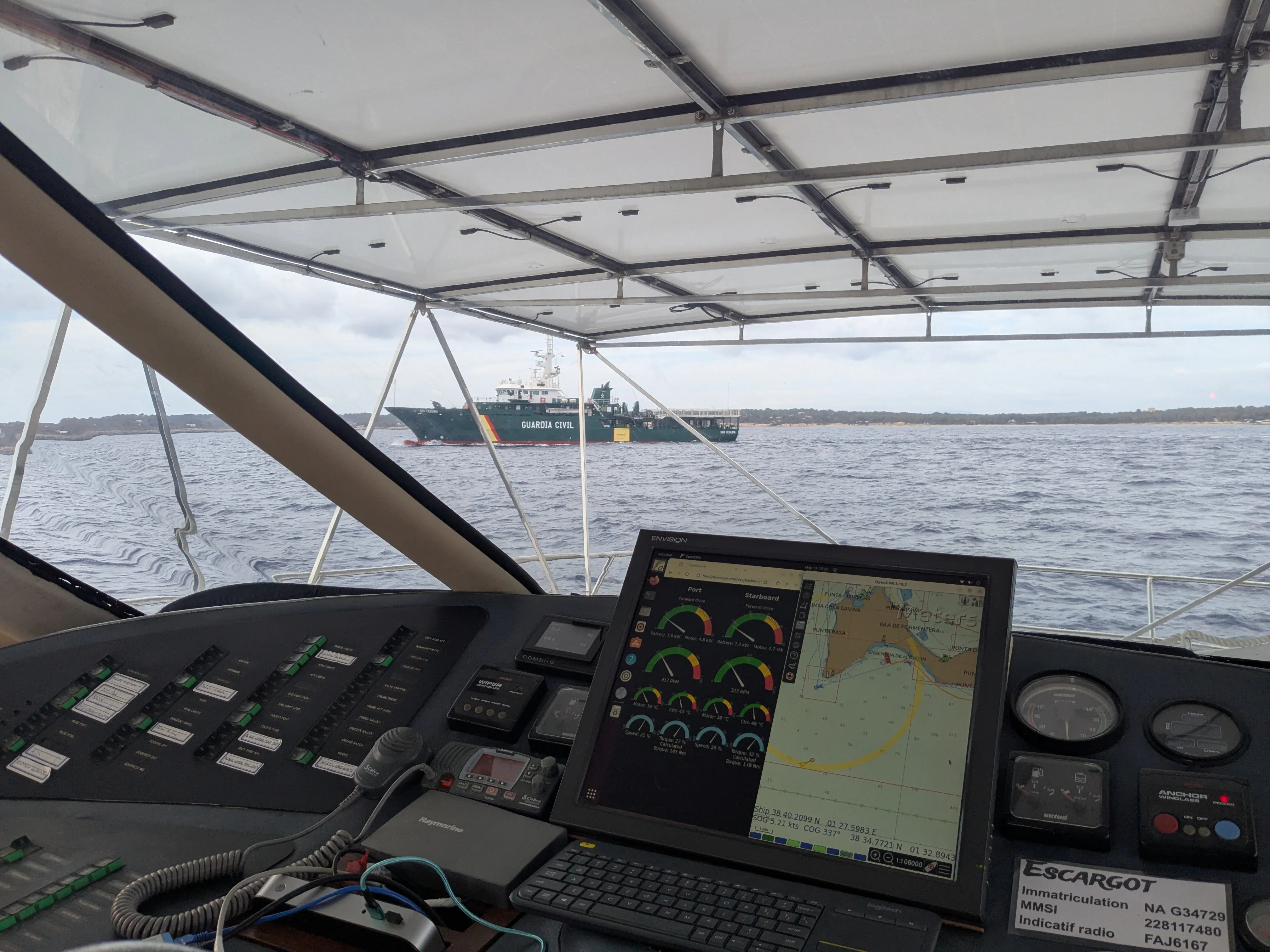
After rounding Cape de Barbaria, we headed north with the waves behind us. We discovered a stunning red coastline and passed Cala Saona, making a note to return when the weather improved. Entering La Savina required careful timing to avoid the constant flow of high-speed ferries. We docked with 54% SOC.
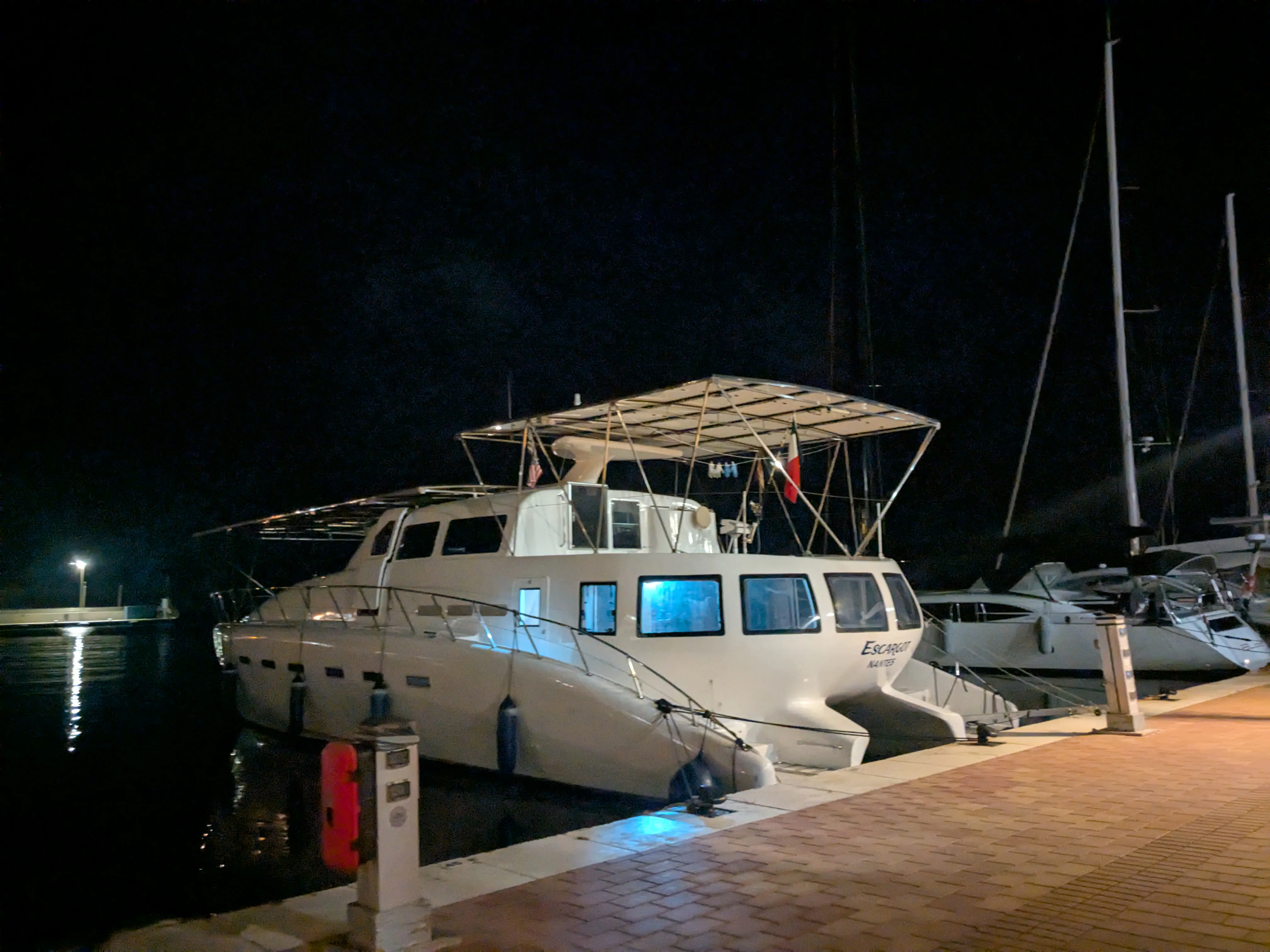
After three days of exploring Formentera by land, the weather cleared. We headed for Cala Saona, knowing this would be our last stop before returning to the mainland. We left the dock at 99% SOC. Exiting La Savina was as hectic as entering; to stay clear of commercial ferry traffic, we pushed the propulsion to 40kW to hit 6 knots and clear the channel quickly.
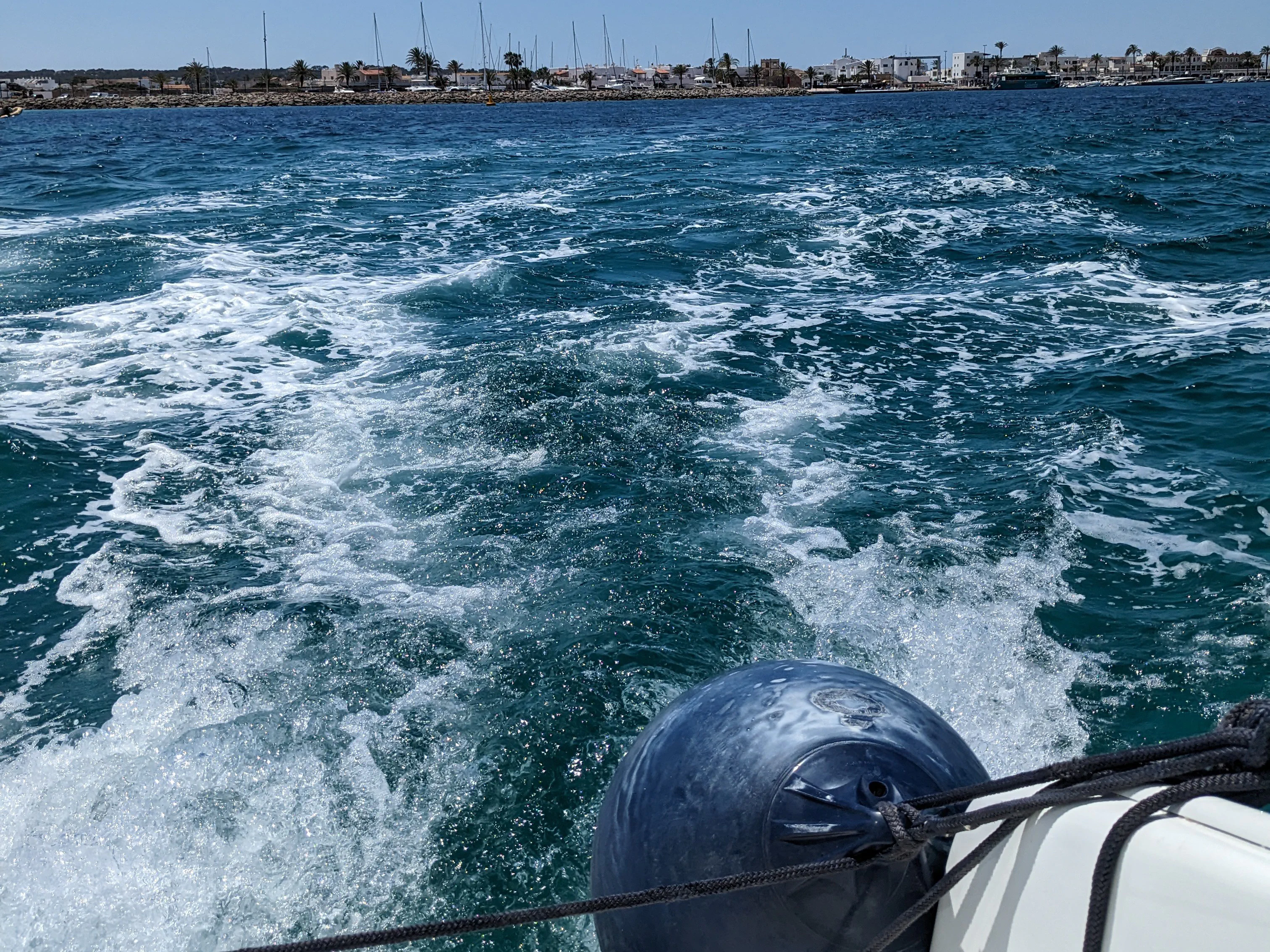
We encountered slightly larger waves than expected at Punta de la Gavina, necessitating 14kW of power.
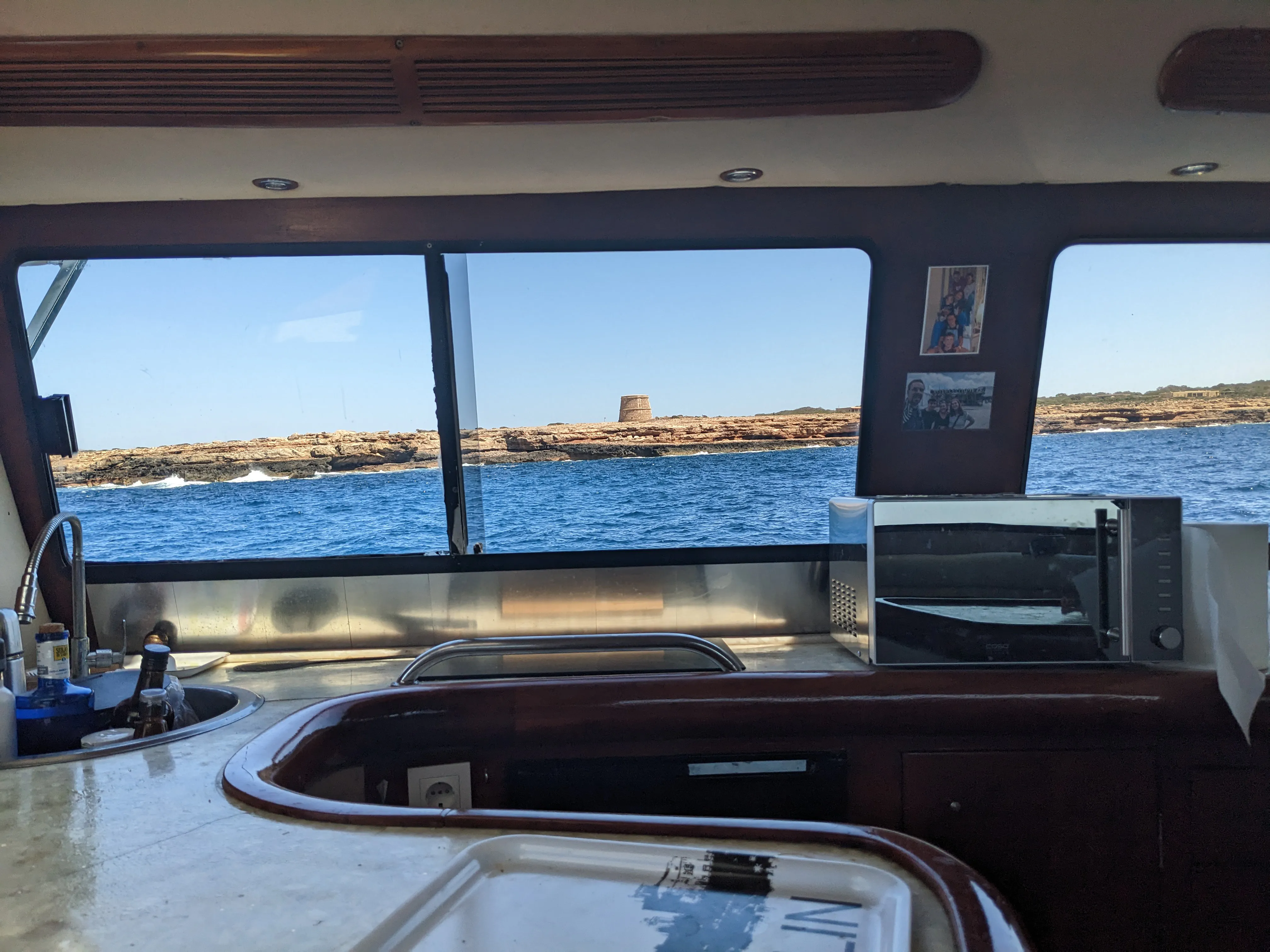
After an hour, we anchored in just 2.5 meters of water. Thanks to the short distance and bright sun, we were still at 95% SOC.
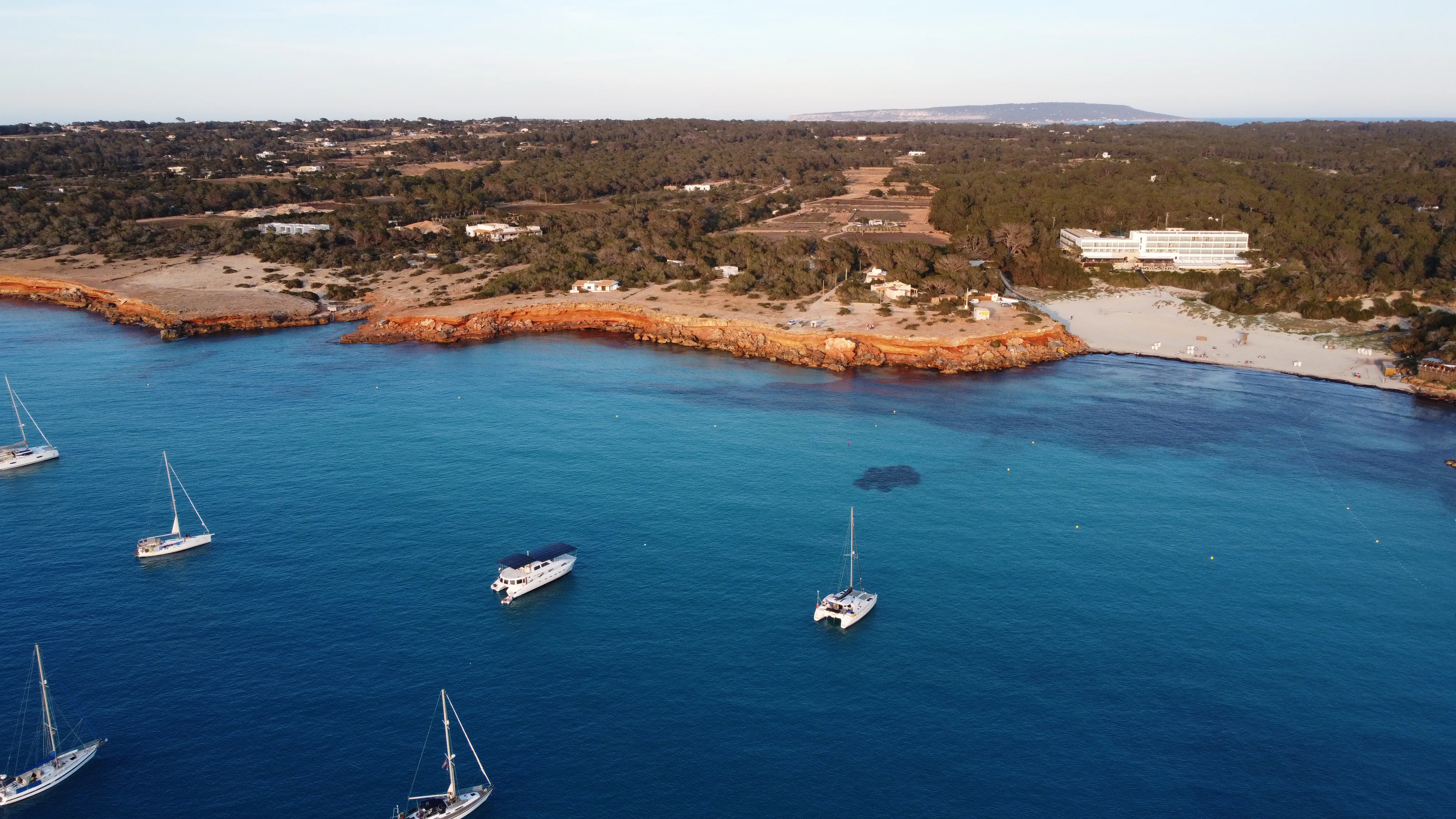
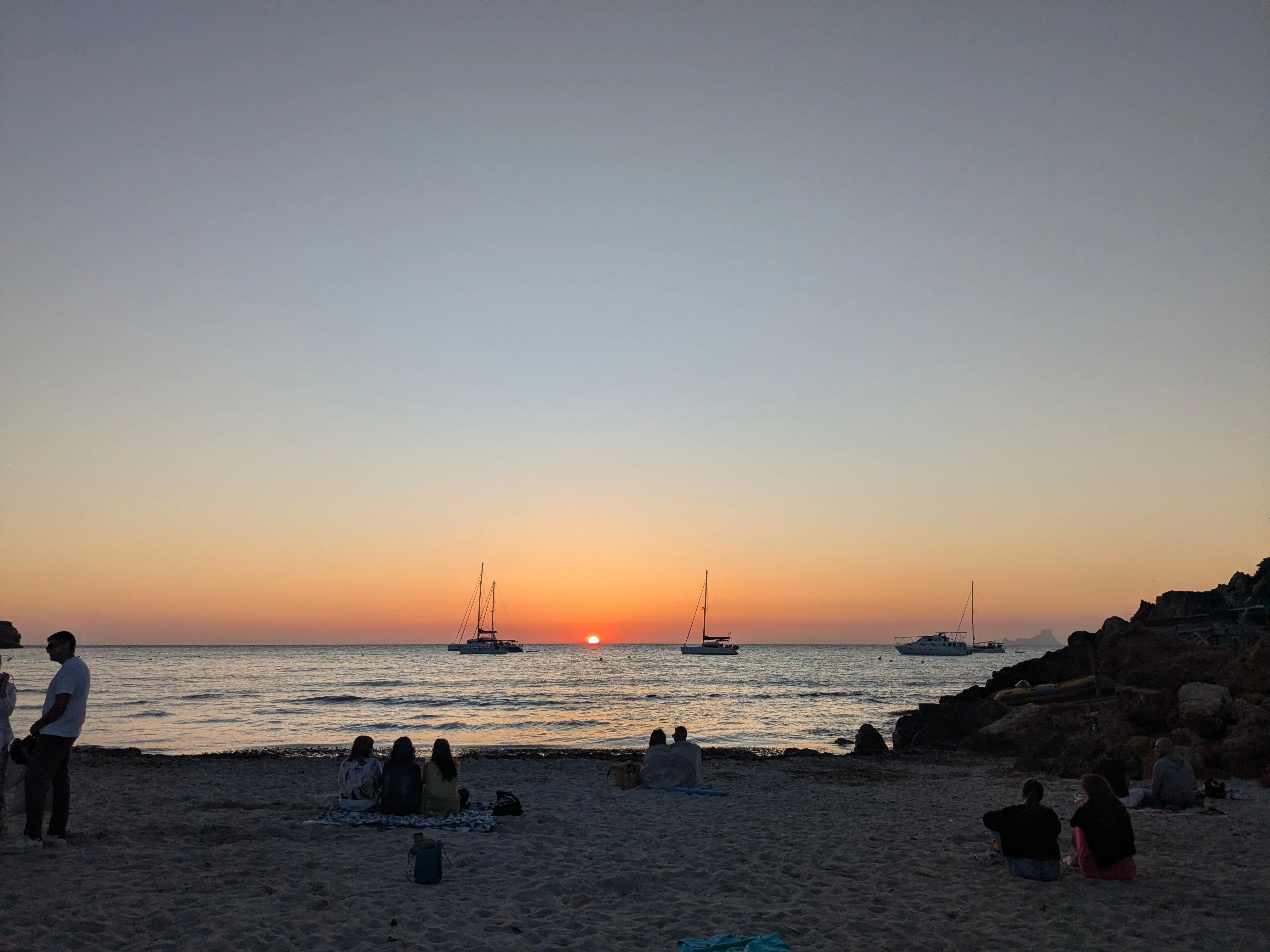
Cala Saona was busy during the day but idyllic at night. The sunsets were a true highlight, with crowds gathering on the beach to watch the sky turn brilliant shades of orange.
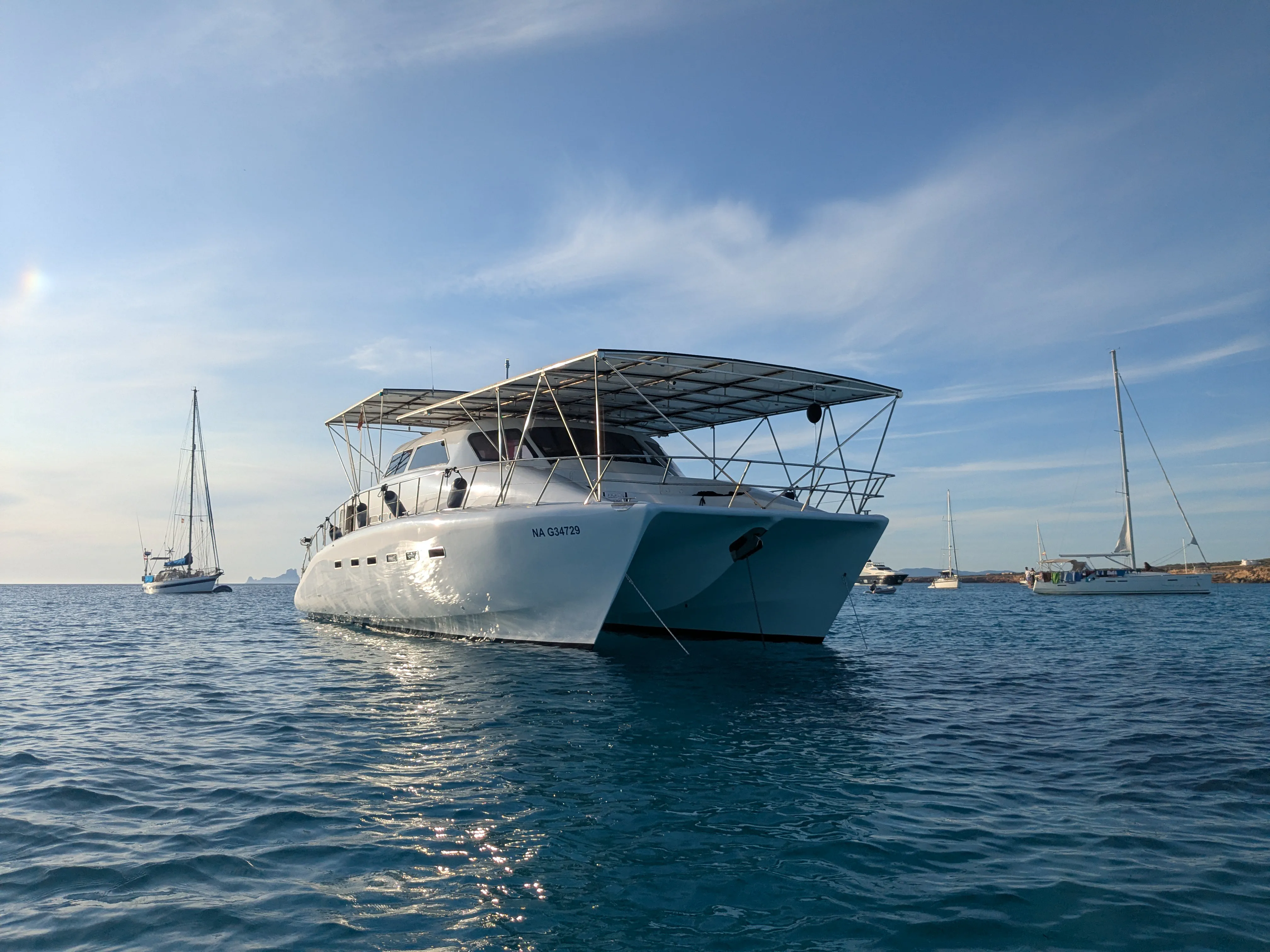
We spent our final two days swimming and performing routine maintenance.
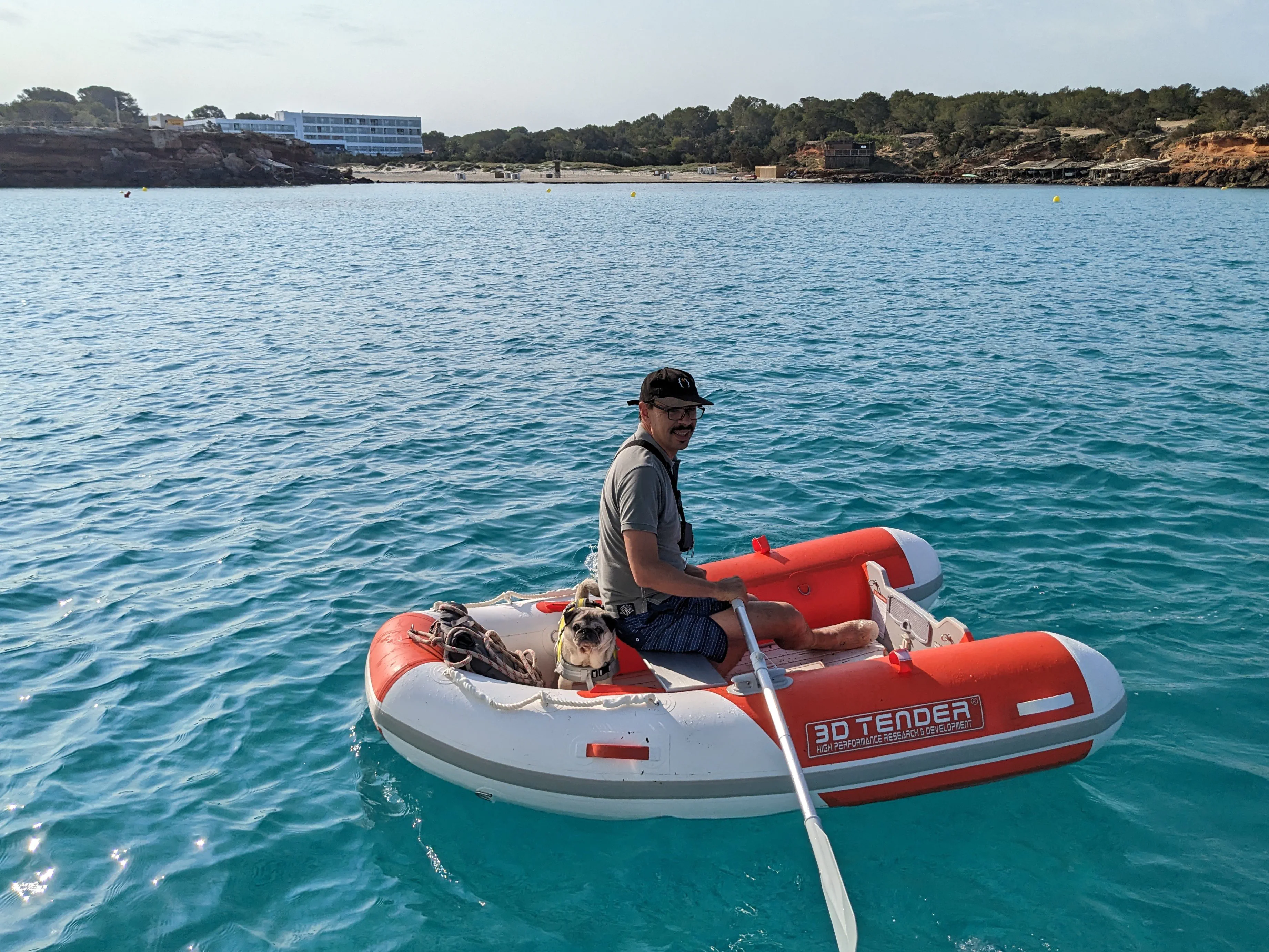
To reach the beach, we rowed the dinghy instead of using the electric outboard, a pleasant daily workout.
A favorable weather window for our return was confirmed, so we prepared to depart to meet our early June schedule.
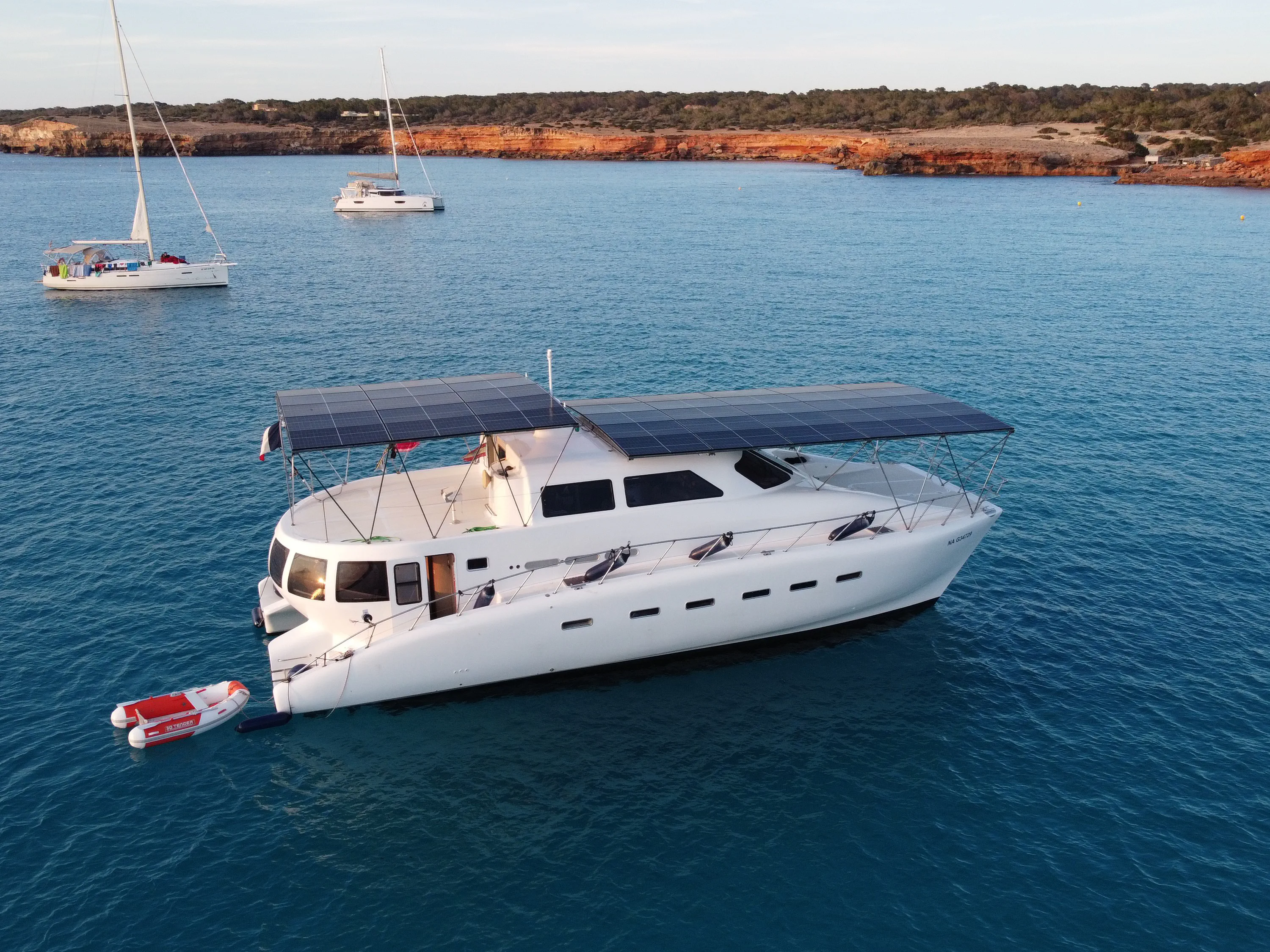
We decided to leave at midday for our first night passage, aiming to arrive on the Spanish coast by sunrise. At 11:10 AM, after tightening our rudder fixtures (a recurring issue), we weighed anchor with 100% SOC.
We maintained 10kW to match solar production, keeping our batteries full until 4:00 PM. As the sun dipped, we reduced consumption to 8kW, and eventually to 6.5kW (4 knots).
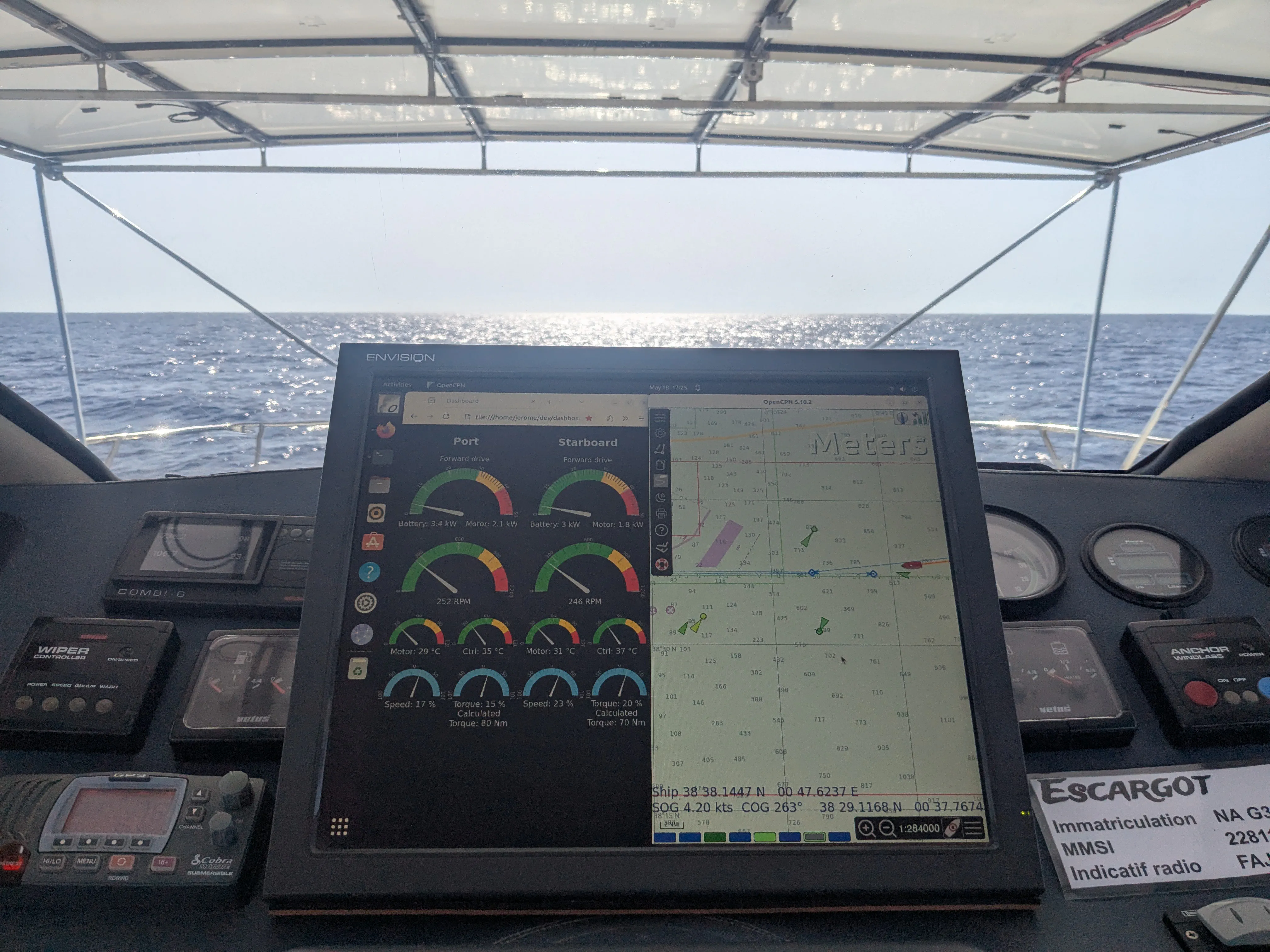
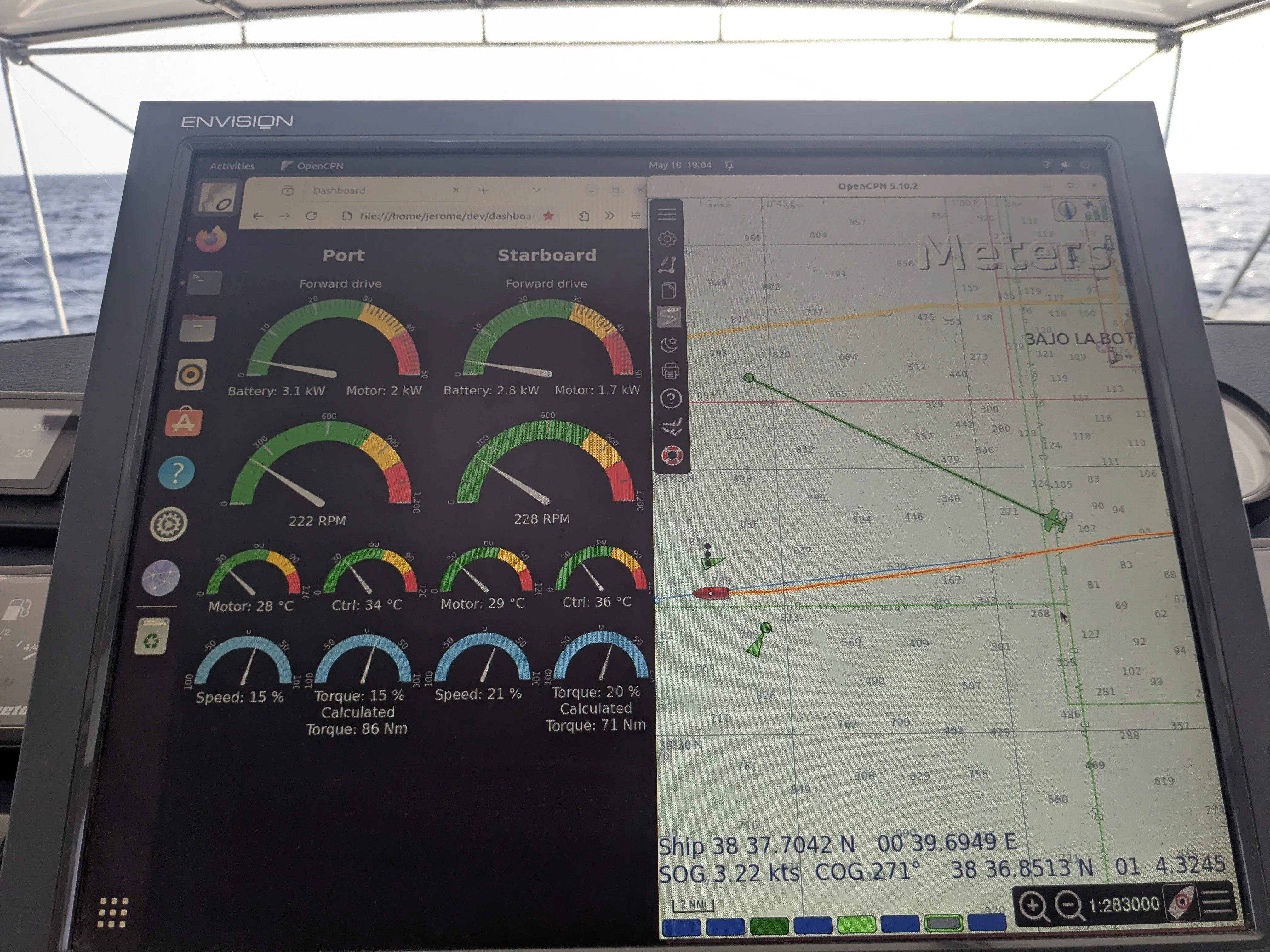
By 7:30 PM, we were at the midpoint. We dropped to 4kW (3 knots), which gave us a 24-hour battery range, more than enough for the 10 hours remaining.
We turned on our navigation lights at dusk. There were no other boats on the horizon and no land in sight.
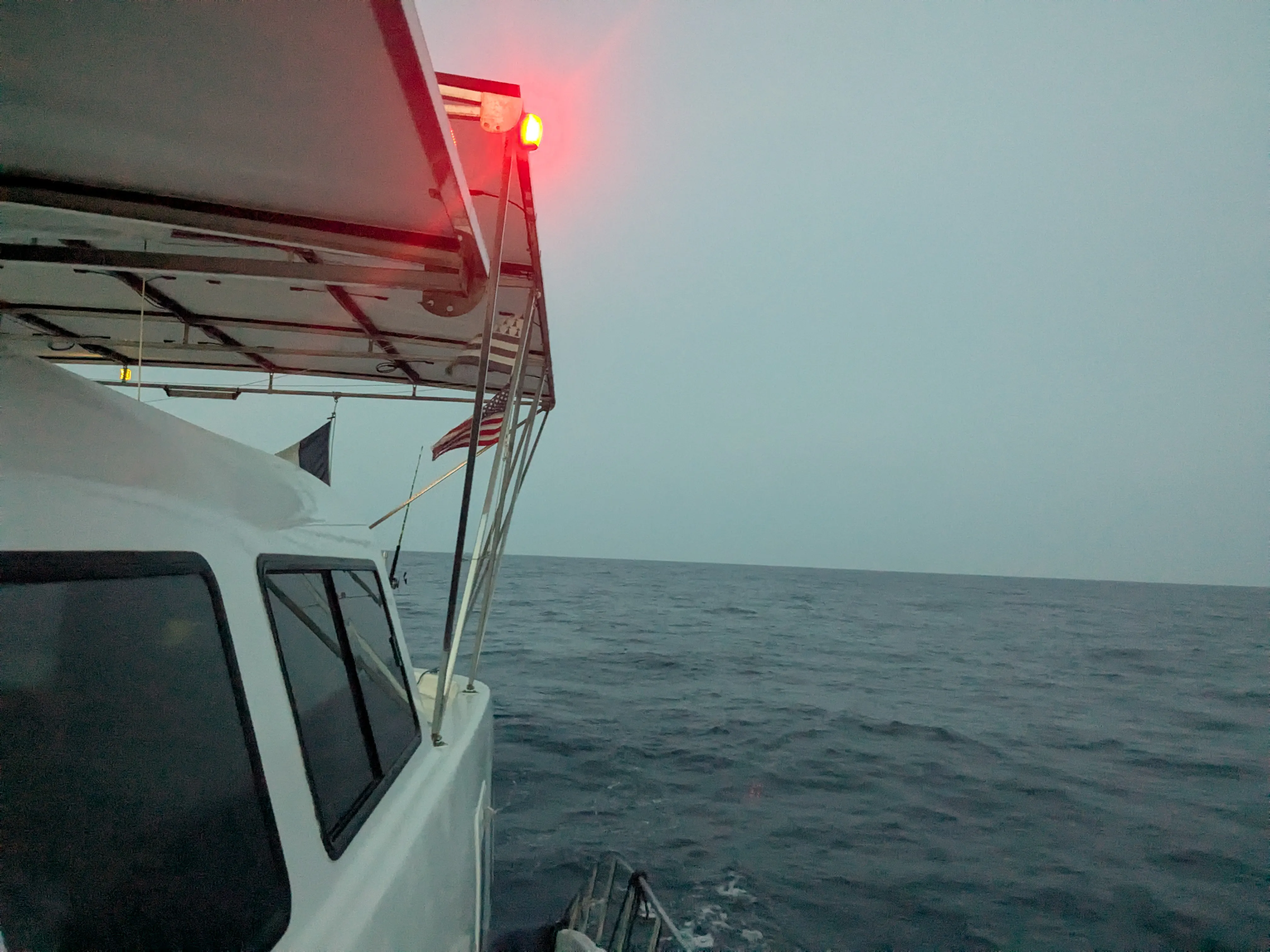
As night fell, we began our watch rotation, monitoring AIS targets of cargo ships and fishing vessels.
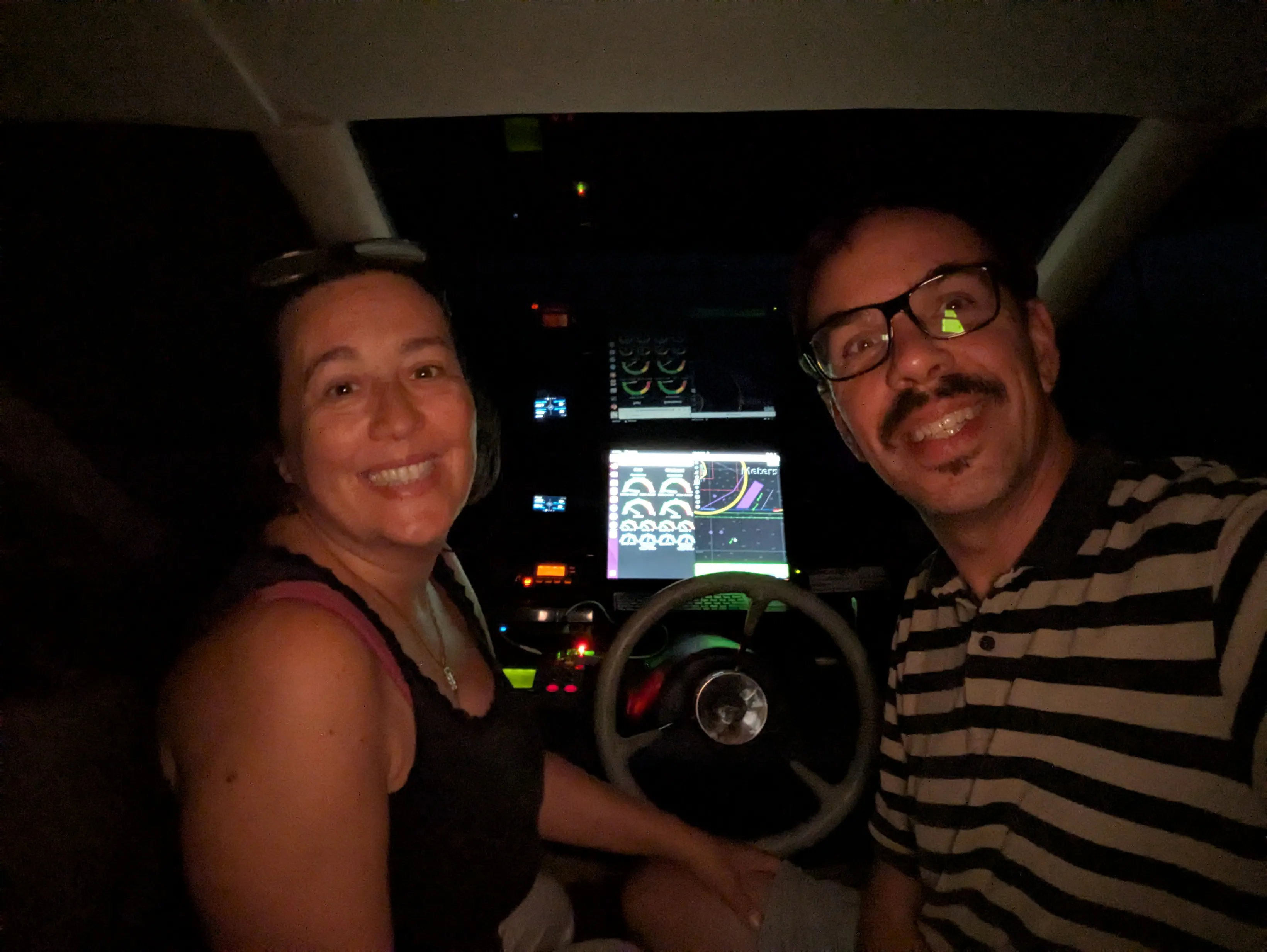
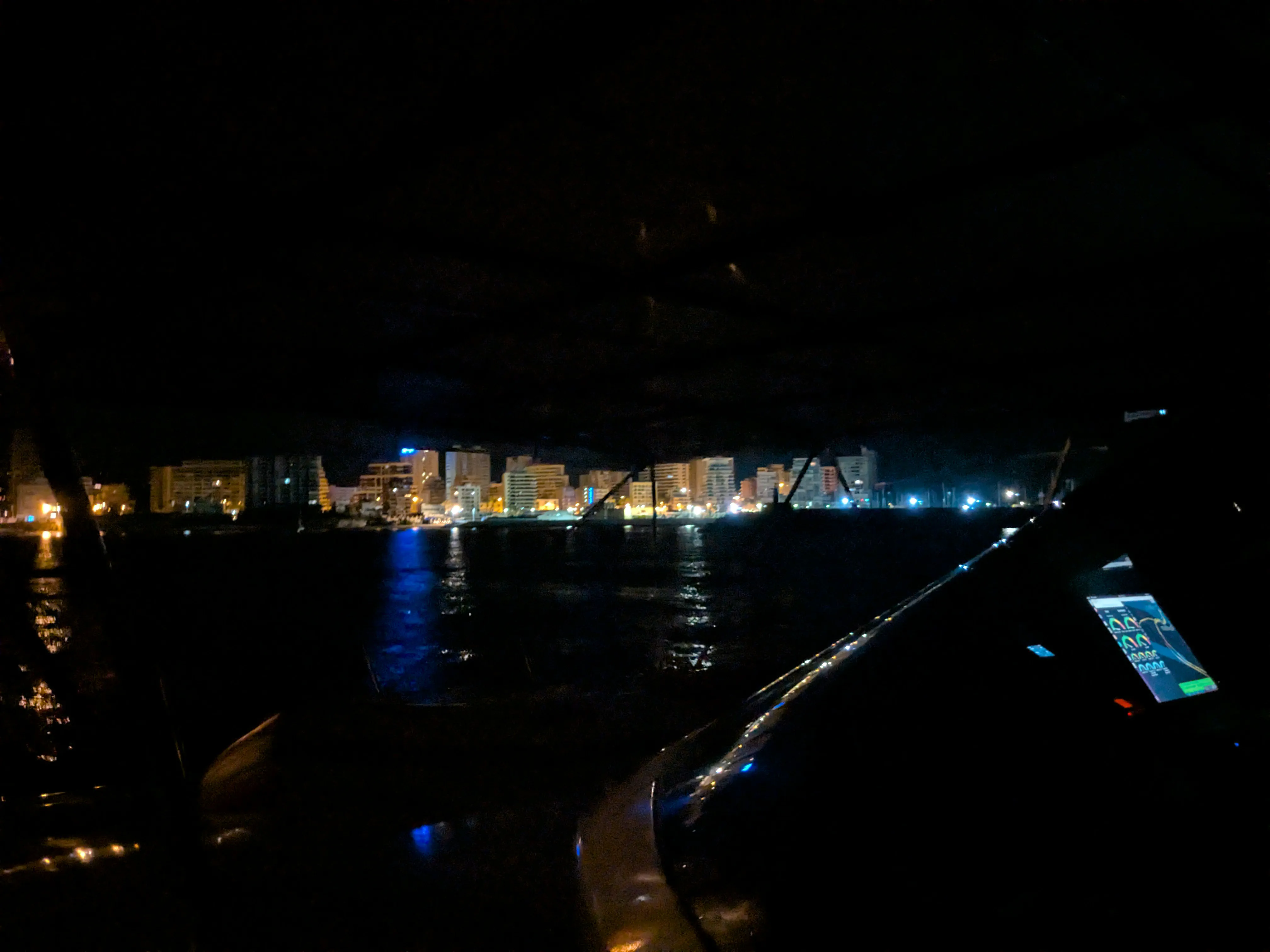
We reached Calpe at 5:00 AM. The marina was full, so we anchored near the entrance. We finished with 44% SOC after 63 nautical miles.
The rudder issue was becoming a significant nuisance, and the port seawater pump was now showing signs of failure. I needed to schedule a day of work to rebuild the port cooling circuit before our final leg.
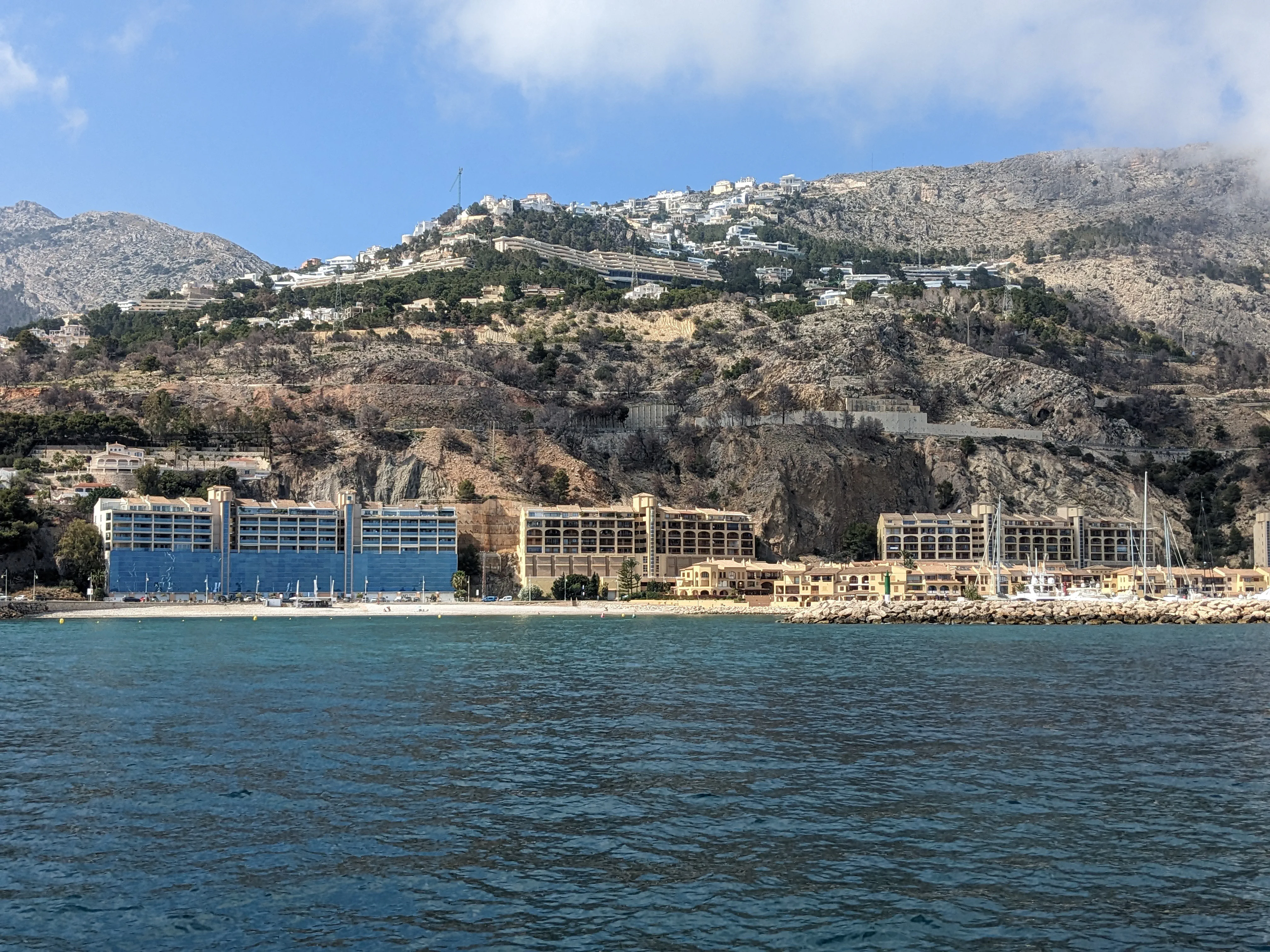
After a day at anchor, we moved to Marina Greenwich in Altea to tackle the port side cooling pump replacement. We left with 96% SOC.
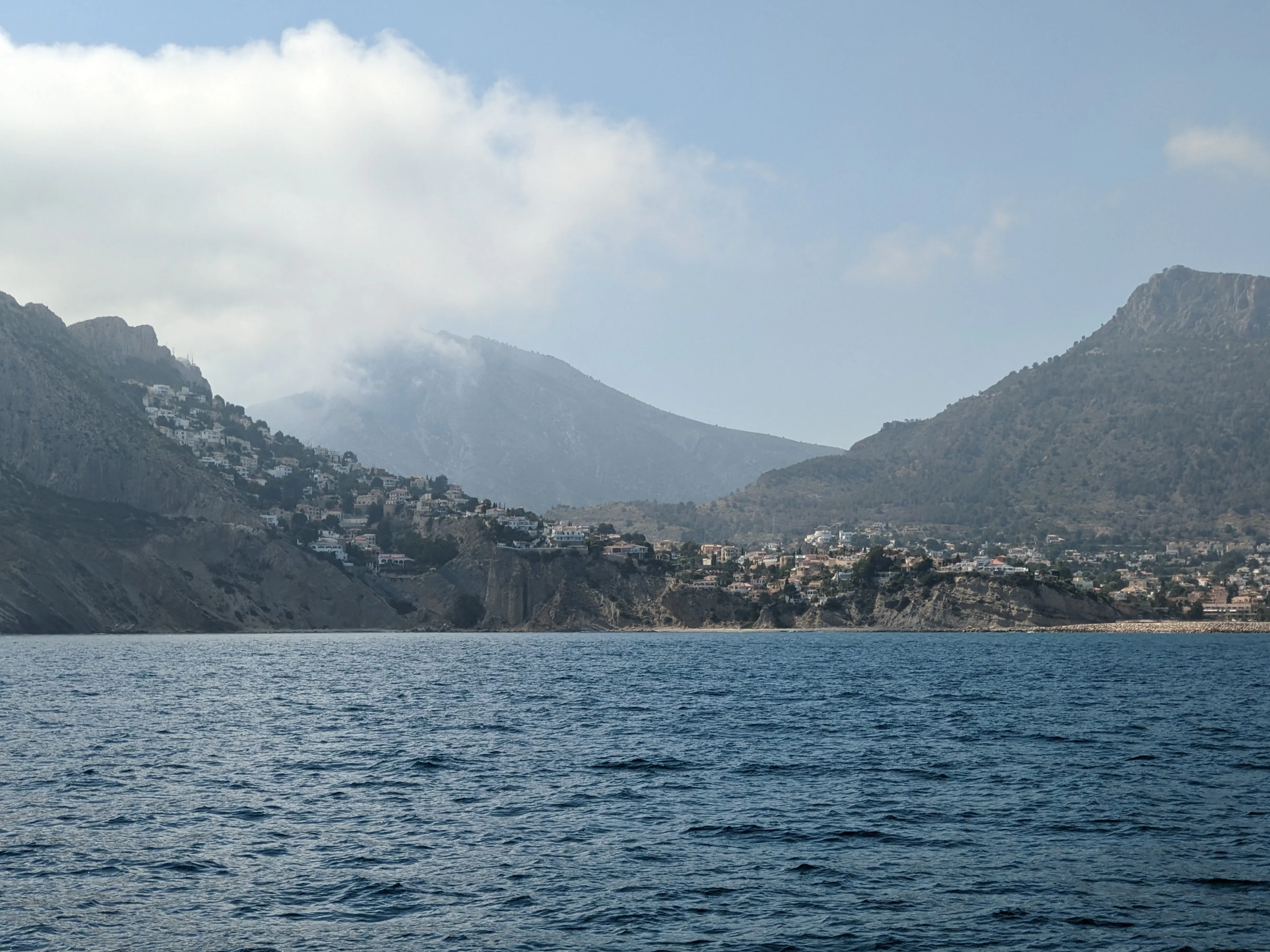
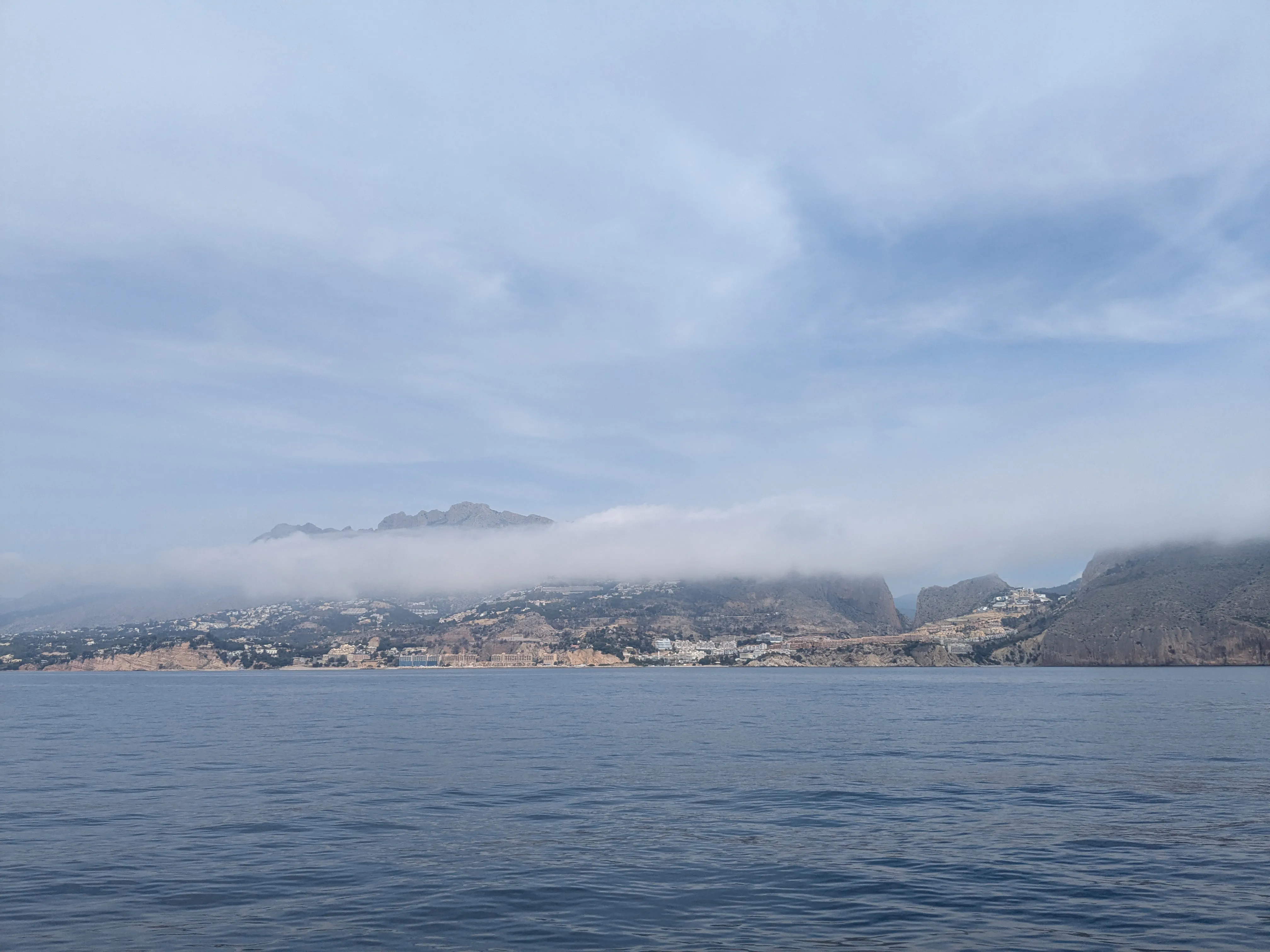
We cruised at 4.5 knots, enjoying the massive cliffs between Calpe and Altea, and docked with 90% SOC.
Our following leg was to go anchor in San Gabriel, Alicante. We left with 99% SOC and perfectly calm seas.
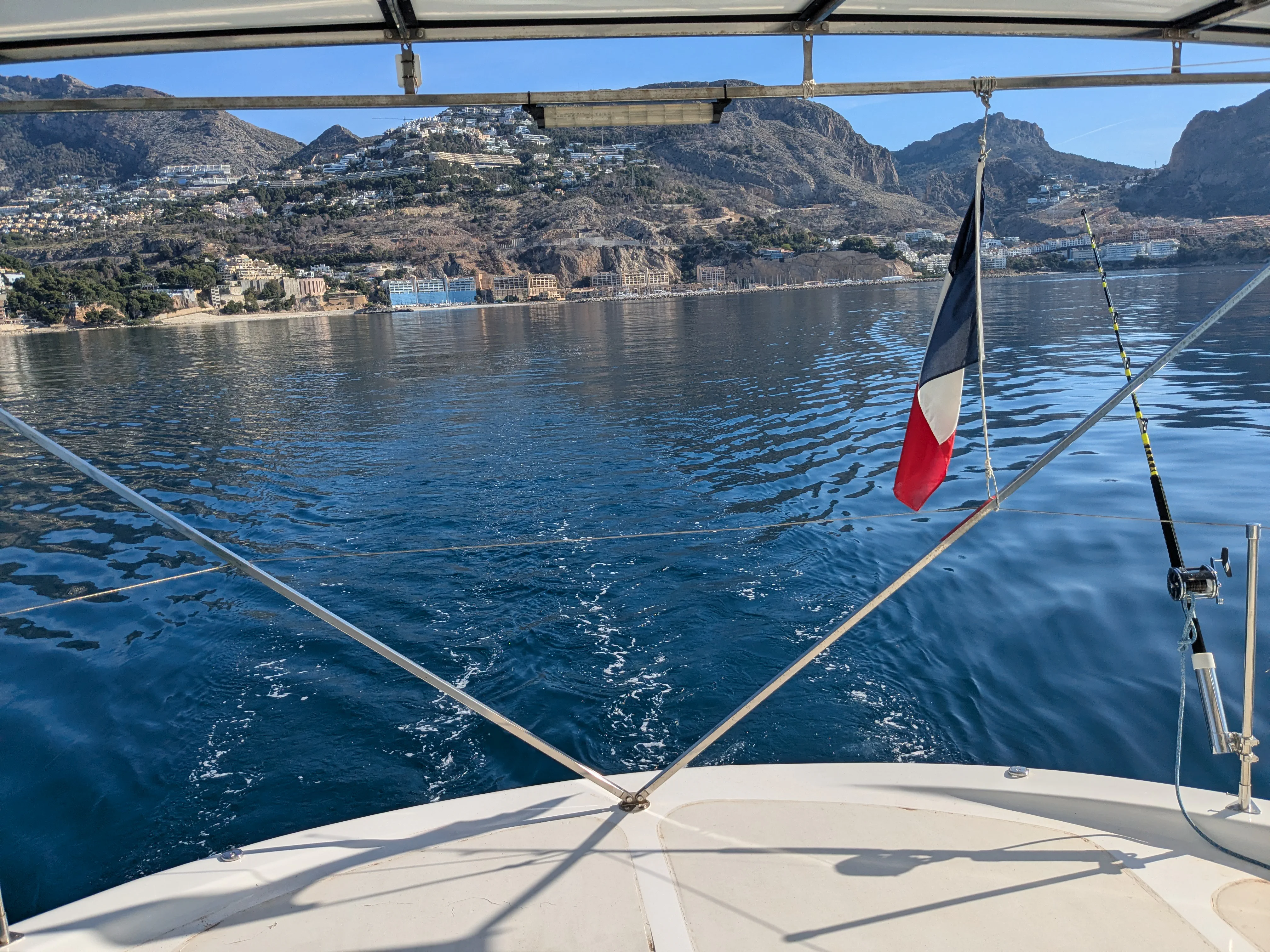
The navigation was smooth, though we fought a slight counter-current. By 5:00 PM, we passed the Rock of Alicante with 94% SOC. However, the sea state worsened, and we realized our intended anchorage at San Gabriel was unprotected from the swell that shifted west south-west. We decided to push through to Torrevieja.
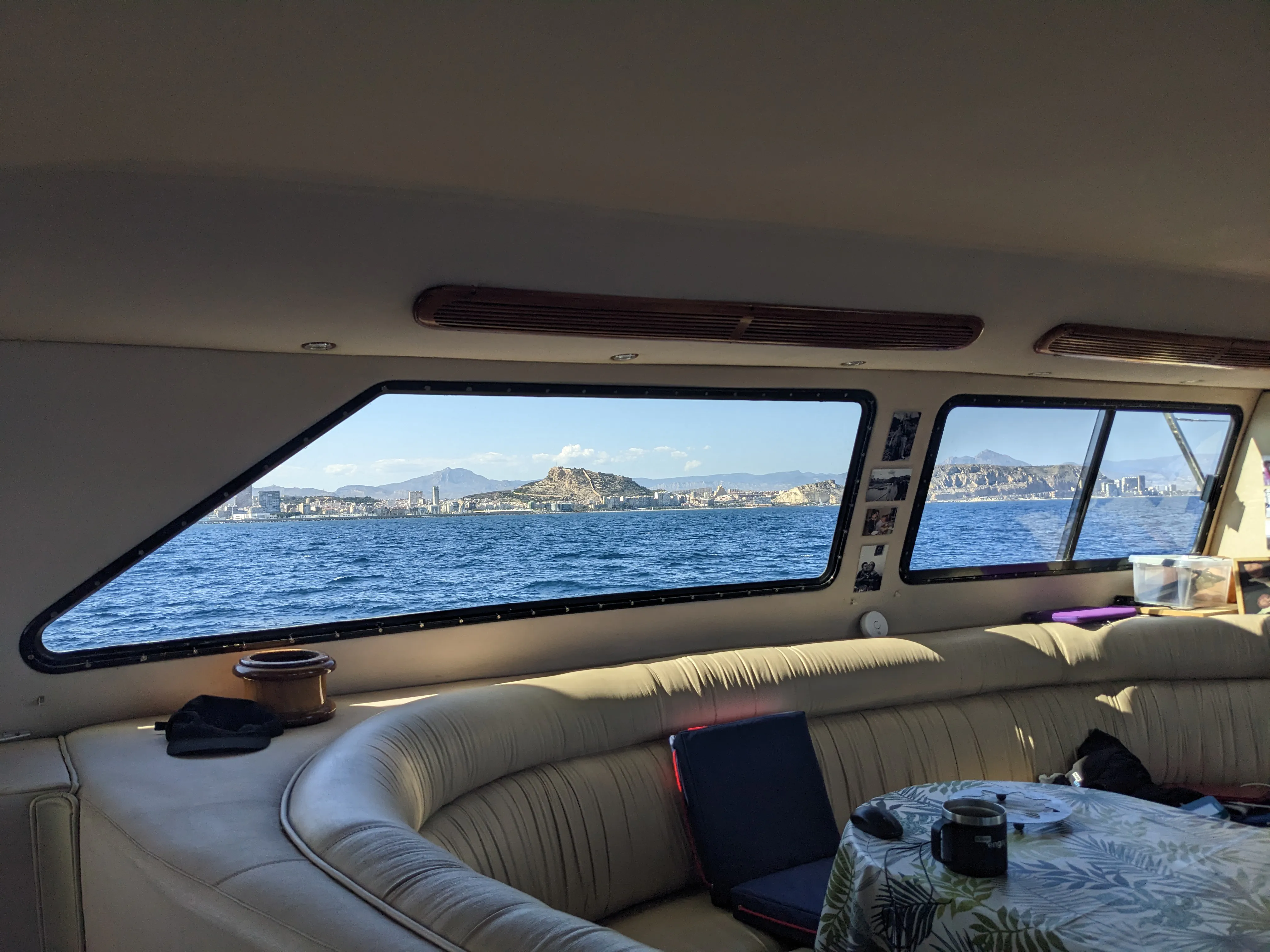
We passed Tabarca at 7:30 PM with 81% SOC against the current.
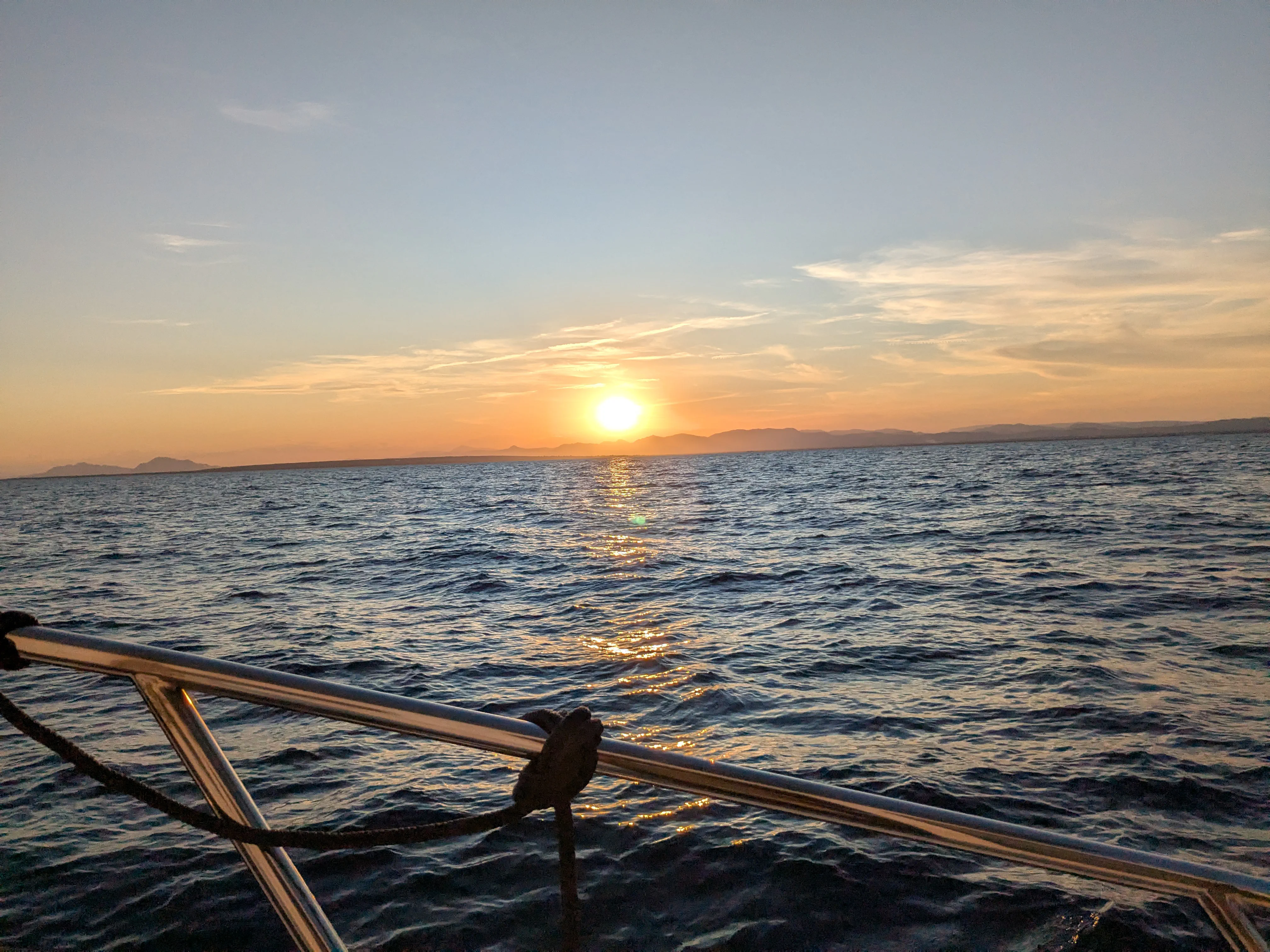
We finally anchored inside the port of Torrevieja at 1:00 AM, with only 11% SOC, the lowest we have ever run the batteries. It was time for a well-earned sleep.
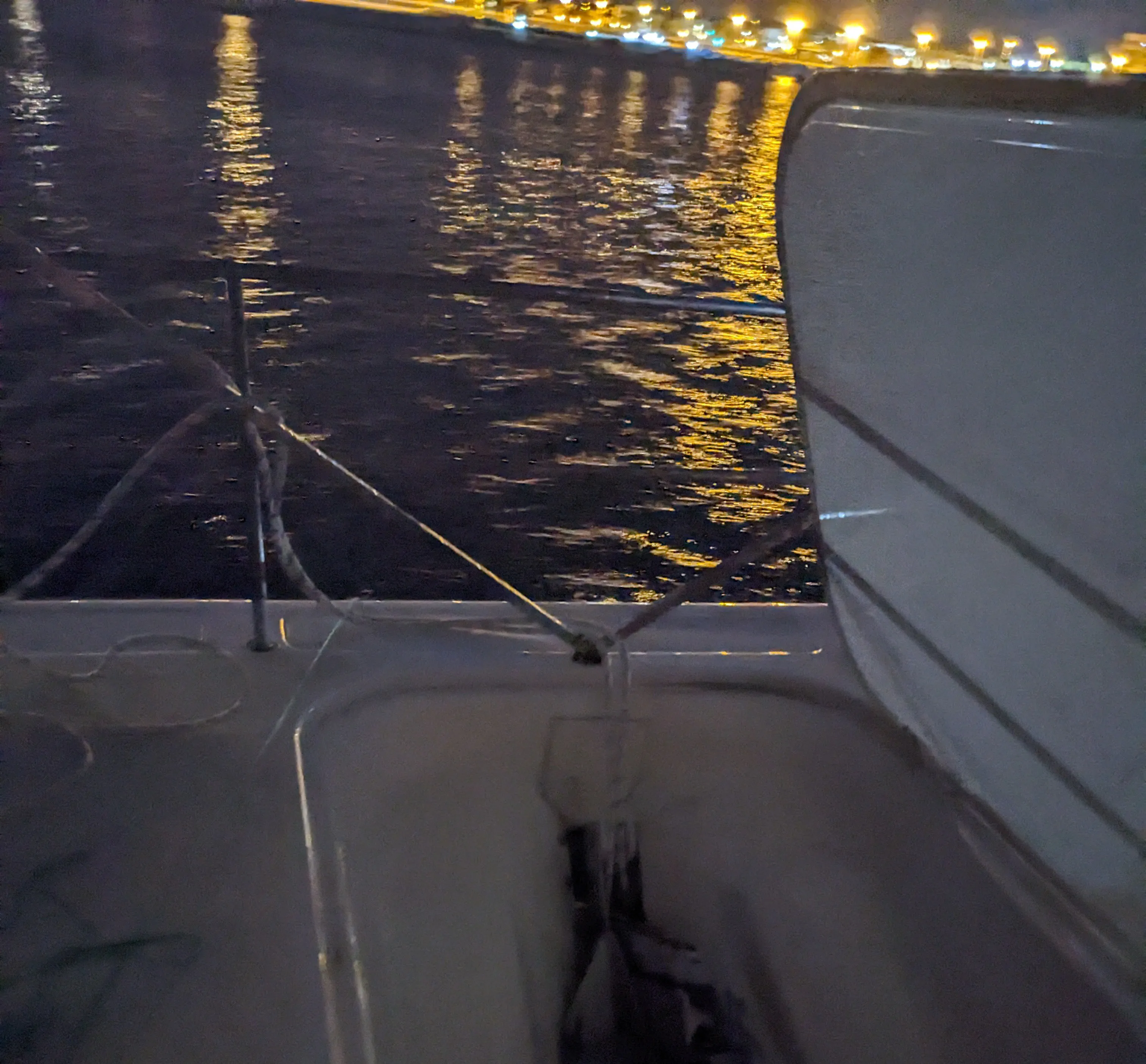
Our final task was moving to our summer berth at Marina Salinas. Though our fishing luck had been poor all season, we found a single sardine that had jumped onto our swim platform, our only “catch” of the year!
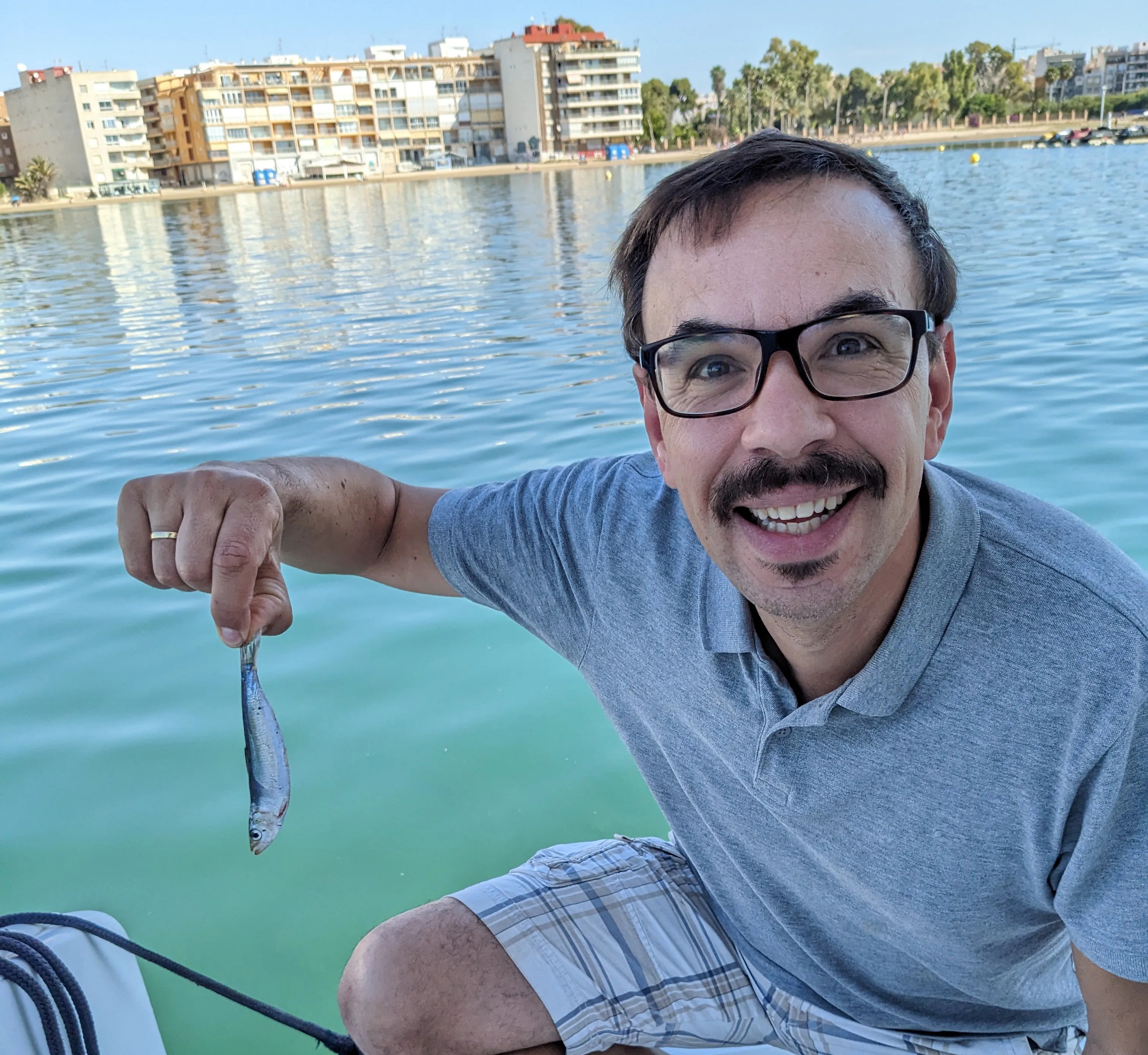
We lifted the anchor at 10:25 AM with already 23% SOC and we docked 25 minutes later with 25% SOC. This concluded an exciting spring season covering 366 nautical miles in six weeks. Now, it’s time to prepare Escargot for the summer as we head home for a very special event: our daughter’s wedding!
We kicked off our fall season by hosting several friends onboard before continuing our navigation along the southwest coast of Spain. Because we …
We returned early to Escargot for our spring season living aboard after being away for only two months. We started with a couple of short trips in …